Saturday, 7 April 2012

Nice - Words by Ben, colours by Niki

The Loch Ness monster seems ready for a party. However, I think the glitzy sculpture by Niki de Saint Phalle wouldn't scare a fly even if it tried. You can't exactly say it is guarding the entrance to MAMAC, the Museum of Modern and Contemporary Art of Nice, France. Underneath the tall marble building flows the Paillon river which continues its journey underground past the bus station and Massena square, until it meets the Mediterranian.
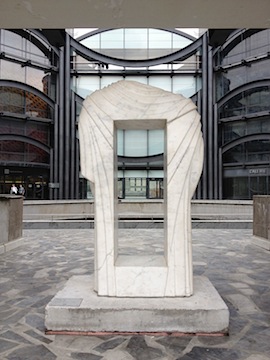
Sasha Sosno's sculpture Drapé dans le vide looks like a very inviting entrance into the world of art but I choose to enter the museum instead of the artwork. Down below a street is busy with cars and there is also the entrance to the city library. A group of young people is listening to music, someone is dancing, another steps aside and sits down to write in a shabby notebook. This is a cultural centre indeed.

MAMAC is very welcoming: there is no entrance fee. You are simply asked your postcode, but for foreigners it suffices to say which country you are from. I'm not so crazy about the art in the current exhibition but when I get higher in the building, the permanent exhibition starts to make an impact.
An enthusiastic guide is telling about Niki de Saint Phalle's La mariée sous l'arbre, Bride underneath a tree (1963-64), to a group of students sitting on the museum floor.  The tree of life is colourful but below it the story is white, frozen.
The heart of an old bigot (Coeur de vieille bigote, 1964) is full of stuff: housework, religion, good life. White and clean. However, Niki de Saint Phalle isn't just about white. She is about colours.
For instance, the four women in a fountain  (La fontaine aux quatre nanas, 1974-1991) are having a great time. Unfortunately this work of art is now without water...
And what about Sagittarius vase?  It would be weird to hide the pretty lady among a bunch of flowers.
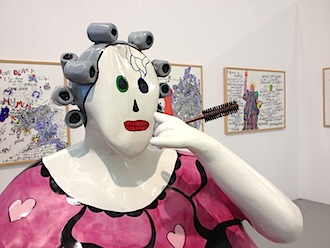
The pale, plump lady in her pink frock really needs to do her makeup (La toilette, 1978) but I'm sure many a skeleton would easily surrender their heart to her.
The student group has also advanced to Yves Klein room with its fabulous blue and gold. The striking blue, or a similar shade, can be found also in some of Niki de Saint Phalle's works but that is no surprise: both artists were part of the French New Realism (or Pop Art) group, and Niki was the only woman included. Blue and gold are in the main role also in the relief portrait by Yves Klein which depicts his fellow artists: Claude Pascal, Arman and Martial Raysse.

In the next floor I arrive at a room dedicated to École de Nice - School of Nice. There is a room within the room:  Chambre privée. From a distance the black and red room reminds you of the Far East but it is a work of art by local artist Ben. His private room is full of surprises and challenges.
I step inside the black room, illuminated with red light. There is a question on the floor: How do you know if this is art or not? The black walls and ceiling are also full of different works of art (if you can call them that!), Ben's messages to the world.
It is essential that I communicate, l'essentiel est que je communique. There is an easy chair that says: to rest here is art (se reposer ici est art). The messages are written in Ben's unique handwriting. I am real, je suis réel. You can also see the laughter of John Cage as well as Ben's - written side by side, framed. You could spend absolutely ages exploring this little art room; this is a whole exhibition in itself.
If art is everywhere, it is also in this box, si l'art est partout il est aussi dans cette boîte. The same message is written on each side of the plastic box - in French, English, Italian and the local language Nissart.  When you're looking at Ben's artwork, it really makes you wonder what is art, what is not.

Before going down, I take a tour on the top floor terraces which offer a great view over Nice and its surroundings - and some works by Yves Klein as well. If only it was a sunny day....
Once I'm again at street level, I take a stroll round the box head guy - Tête au Carré by Sasha Sosno. It is actually part of the city library but you'd have to enter it from down below...
On the park between the box head and the art museum you can also meet a prickly fellow: a version of the Michelin man by another Nice artist, Max Cartier.
I turn to walk back towards the city centre. On the way, I stop for some more Ben - you can find his art also on tram stops. At the Old Cathedral stop, Ben says: Je doute de tout, I doubt everything. On the other side of the tracks the message is Être c'est être différentto be is to be different.

However, there is one more place to walk to: hotel Négresco on Boulevard des Anglais...
...because I've often wondered who is the artist behind the joyous Miles Davis sculpture next to the main entrance to hotel Négresco. I've finally found the answer to that puzzle today - thanks to MAMAC and the artist Niki de Saint Phalle!

every image is 1/25 seconds of life and a moment that never returns
- Ben

Friday, 6 April 2012

In France: Antibes - Juan-les-Pins

A little detour in southern France while Finland is slowly waking up to spring... The weather forecast promises rain for today but it is a forecast à la Antibes: I can see the wrong kind of clouds only in the distance. Despite that, I keep the goretex jacket in my backpack. You never know.

However nice the old town of Antibes is, I long for some nature instead of pretty streets lined with shops. Just have to be careful of the cars on the very narrow street going south. The pavement is so narrow that you can hardly call it one.
A group of petanque players has gathered in a park by the sea and the few sunbathers on the beach seem sleepy. More sun, anyone? We stop for a snack at Ponteil beach. The large waffles look better than they taste but with Nutella on top they become very edible.
The harbour of Salis seems to be for small boats, used by ordinary people and not millionaires. I look for the Chemin du Calvaire which will lead us to the top of Notre-Dame hill. The wide, paved and for the most part fenced footpath turns to the right and we start the easy climb towards Garoupe lighthouse (phare) and chapel. The houses on the left of the path are well hidden behind the fence but luckily there is a forest on the right.
Should we choose the first possible entrance to the right to explore the forest? It looks inviting and surprisingly wild, not too much like a city park. Not yet... We walk on Chemin du Calvaire, admire the fresh green of the ivy leaves and follow the surprised salamanders' escape from the warm rocks at the edge of the footpath. A young couple carries bags full of groceries and walks briskly past us.
Suddenly I smell some smoke in the air. There is an open fire behind the fence in someone's garden, but luckily there's nothing cooking, it would be too much to bear! I wonder about the altar-like constructions that appear along the path. Each has a different message, marking the Christ's footsteps. We are, after all, on Notre Dame hill, and this footpath leads to the chapel. There have been pilgrims on this path already in 16th century.
We finally give in to the call of the forest and turn right to the soft, wide path underneath beautiful, tall trees. There are dark squirrels racing up in the trees as well as on the ground, and a magpie walks slowly across the path. This place makes you forget about the busy city traffic down below.
I stop to look at a tree in bloom; the leaves look very familiar. Is it a laurel? Perhaps. Over here, I should be carrying a tree guidebook to recognize them all; Finnish nature has different flora. I can't help wondering how this little forest in Garoupe has managed to remain as it is although the area is otherwise so densely built.
It is a pleasure to stroll here slowly, beneath the green trees. A shallow, weird looking concrete block looks out of place on the ground but with a closer look at the remains you can see it was once a squat toilet. A narrow side path leads us to a wall but there's a hole that lets us back onto the road - we're very close to the top of the hill. Only few more steps to go.
The easy climb was definitely worth it - the view from the top of Notre-Dame is fantastic. The coastline to the east includes Antibes and in the distance looms also Nice. The clouds unfortunately block the view somewhat and it's not possible to distuinguish for example Mont Bégo (up in Mercantour National Park) in the distance. The worn out but good mosaique map would be a great help in mountain spotting on a clear day.
Behind the chapel of Notre-Dame there is a red and white lighthouse of Garoupe, keeping on eye on the coast and warning the seafarers. I rub my fingers on the lavender bush next to the chapel before we take off and start to descend towards the path round Cap d'Antibes. We also get a glimpse of the coastline to the west towards Cannes; the Mediterranian sparkles in the sun. 
For now we have to do with walking on the side of the narrow road; sometimes there is a pavement and sometimes there isn't. So glad it's not yet a busy summer month with heavier traffic. The houses by the side of the road are mostly hidden behind heavy fences and gates, and some roads are marked private. In places you can however get a glimpse of how the wealthy live (or at least of their rooftops)...
The road is already heading downhill, towards the sea. Wish I could sample some of the oranges or lemons that are growing by the side of the road... We reach a church which acts as a landmark: we'll take the second turn to the right.
Once we've taken the second turn to the right, a familiar yellow trailmark greets us. The yellow colour tells that we are on the path called Sentier Touristique du Tirepoil which will take us round Cap d'Antibes. This first stretch doesn't of course look like much but we'll get to the actual footpath once we've reached Garoupe beach.
The path is clearly marked at the end of the parking lot on the right side of Garoupe beach. The Mediterranian Sea will remain on your left for the rest of the path - not bad, eh? On the right a stone wall will guard the happy houseowners' privacy for the whole way. At the start of the 2.7 km trail there is a warning sign that reminds you of some more difficult bits and about the fact that the path may be dangerous when the sea is rough. This is no joke.
However, in this weather the trail feels like heaven when we pass Pointe du Cap Gros. The path underneath is fairly even for part of the way but in some parts you really have to watch your step, especially when the ground gets rocky or when descending or ascending steep steps.
The glittering sea remains very close for most of the way. Here and there, there are steps that lead right to the sea - especially in front of villas that hide behind the massive stone wall. You can also stop to listen to the sounds the waves make when they hit the rocks.
The path itself is fairly fair and colourless but it doesn't mean that the environment lacks colour. As early as in April you can already enjoy some flowers or bushes in bloom. For example, there are quite a few yellow flowered bushes next to the path and also pretty tamarisks the tiny flowers of which remind me of heather. And there is a bouquet of flowers, and a plaque... for 15-year old Sabrina who died here, hit by a wave across the path, in 1997. Beware of the sea.
Here and there the path dives through trees or bushes, and once we walk underneath a pretty half-moon shaped terrace. There are quite a few people taking a walk, in both directions, but the path is not extremely crowded - you still get to enjoy some peace and quiet.
The path reaches a tall wall on top of which you can once again enjoy the scenery. After that, the path continues a bit further to the Bay of Millionnaires (doubt you'd be able to spot them though) but we decide to call it a day and take a sharp turn right to Chemin des Douaniers, following the yellow routemarks, to finish this sentier. Behind the wall on the left there is an eco-park where 54 olive trees were planted at the turn of the millennium, one for each child born in Antibes - Juan-les-Pins area during the first month of the year 2000.
Once we've come a full circle to the start of the circular tour of Cap d'Antibes, we continue our journey along the winding roads towards Juan-les-Pins. The road soon arrives back to the seaside.  Most of the old wooden fishing boats are still ashore, waiting for the fishing season to begin.
The Mediterranian see looks simply amazing in the late afternoon sun. There is a solitary sailing boar anchored in the bay, and behind it you can see the island of Marguerite. Somewhere in the distance there are also mountains, surprisingly close to the sea.
Juan-les-Pins seems to be all about newish apartment buildings and a busy port with yachts and sailing boats. However, the park before the Casino seems relaxed enough, with many groups of (mostly) men enjoying their games of pétanque. It would be great to play a game of boules but unfortunately we don't have a set of the required balls in our backpacks. Perhaps next time.

Thursday, 29 March 2012

Almost...white

Viitaniemi, Jyväskylä, Finland. I walk along a road lined with almost off-white, melting snow; almost past an off-white wall, but not quite. Light befriends the shadows on the wall.

Monday, 26 March 2012

Helsinki: the first cup of coffee outdoors

The streets of Helsinki are showing signs of waking up after the long, snowy winter. The dirt is being brushed away little by little. The little pine cones that have taken over these flower boxes may soon have to give way to something less dry and brown. Unless of course this is considered easier to care for...
At Lönnrot park, the statue of Elias Lönnrot is bathing in the sunlight, waiting for the snow to melt away. Elias Lönnrot was a keen walker and he did numerous trips to collect old Finnish folk poems especially in Karelia. As a result he managed to put together Kalevala, the Finnish national epic, as well as Kanteletar, a major collection of Finnish folk poetry. That explains why the statue includes also Väinämöinen, the hero and main character of the national epic. The young maiden Impi represents poetry.
On the sunny side of the park the snow is melting fast. Some spring crocusses are already getting ready to bloom.
Marimekko store at Pohjoisesplanadi street attempts to spread a little colour on the grey street: the joyful bean bag chairs manage to stop at least me on my tracks and also look at the window display which is decorated with large Easter eggs, made of fabric, naturally. 
On the southern side, Eteläesplanadi street, I find some more signs of the end of the winter. A restaurant owner has planted spring flowers in the flower boxes. I hope they will make it through the remaining cold days or nights - you never know about the weather at this time of the year.
Around the corner, on Unioninkatu street, there are hand embroidered artworks on the window gallery. A series of smiles embroidered with red thread on white make you smile, and I couldn't agree more with the bigger work of art, don't worry so much. However, I forget to check who the artist is. Well...why worry about it!
As I walk along Unioninkatu street, I see the sunlight hit a sidewalk table of a small café, Café du Coin.  The tiny café usually only does lunches at this hour (the limited space is reserved for people having lunch) but I step in and ask if I could get a macchiato outside, my first of this spring. A couple of minutes later I sit at a table outside, in the sunshine, and smile. Ode to Spring in Helsinki!

Friday, 23 March 2012

Laukaa - Devil's Icy Grave

If you follow the road north from Jyväskylä to Laukaa, and from Laukaa a bit further towards Valkola, you will see a black sign pointing to the left: Hitonhauta. Hitto stands for devil, and hauta for grave. That of course may not tell you much... I park on the side of the road and decide to take off without my snowshoes and only carry a pair of poles as a precaution, in case the icy surface of the snow gets too slippery in places.
I arrive at a log shelter but it is much too early to stop there to make a fire. How interesting - the fireplace is actually inside the open log shelter, and the smoke will simply escape through the opening at the front (of course there's no chimney). Never seen a shelter like this before. Then again, it must be pleasant on a wet day, to sit in front of a fire that doesn't mind the rain.
The Iso-Harinen lake is right next to the narrow road. Judging by the footprints leading to the ice, I guess they were left there by fishermen who've gone winter fishing. Not a bad way to spend a day, sit in the sun and wait for the fish to bite.
The narrow road leads through a conifer forest and every once in a while there are clear signs pointing to Hitonhauta. Some of the signs are in a dire need of repair, but at least there are good black and white maps attached on some signposts. A bit further, a sign forbids motor vehicles; this is a nature reserve. Finally, a grey wooden sign guides me to turn to the right, into the forest.
Thanks to the snow, the path underneath is not visible, but I can follow the footsteps of the previous visitors. Without them, I would have to rely on the map because I notice only one red trail blaze painted on a tree...And that wouldn't actually take you anywhere.
As the trail descends, the rocks on both sides get more and more steep. When was the last time I was here? It must have been years ago. I've totally forgotten how impressive the Hitonhauta gorge is! And Hitonhauta is what a gorge like this is often called in Finland; perhaps people thought in the old days that Devil's Grave must have been designed by the devil himself.
Actually, the sculptor wasn't the devil, but the Ice Age. It is believed that towards the end of the glacial period, the melting ice was flooding through this area. I know these rocks are nothing compared to rocky mountains somewhere else, but when found in the middle of a Finnish forest, it is quite impressive.
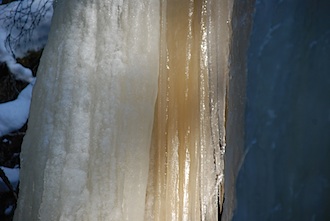
Although the glacial period is over, Hitonhauta can still boast of its own little glacial period that repeats itself year after year, each winter! On my left there is a great icy wall with numerous, massive icicles, some parts of which have already smashed onto the ground.
Hitonhauta gorge is quite a sight, especially at this time of the year. When the spring is on its way, the combination of sunlight, the bright white snow,  ice and the rocks is simply magnificent. On different seasons, Hitonhauta can look totally different.
I continue along the footsteps in the snow, deeper into the gorge which is about 800 meters long. Before I reach another wide opening, the rocky walls are leaning even closer.
There I meet another, perhaps even larger ice wall behind which you can hear water falling and dripping down. The afternoon sun seems to reach this far through the trees on the other side of the cliffs. It is quite a fairytale land...
There are so many different, fantastic shapes of icicles in the ice wall. You could spend ages just looking at those.
Right opposite the ice wall there is a granite wall with a little cave in it. I climb on top of the pile of snow and have a peek but can only see more ice; definitely no going in, if there would even be room to enter the cave. Oh what is that sound which so thrills the ear? I can still heare the sound of the water from behind the ice wall!
I simply have to go back and admire the ice wall once again, listen to the water splashing down, hidden from my eyes.
On my way back I walk slowly, stopping here and there to wonder about the never-ending groups of icicles hanging down from the rocks. There are already so many, and there may be even more, depending on how the spring advances and how the snow that covers the cliffs continues to melt.
Everywhere I look there are little ice sculptures, and whatever glacial artwork you can imagine.
Hitonhauta, Laukaa, Central Finland, is a wonderful place for a winter day trip especially at this time of the year. The rocky path that is now hidden under the snow may actually be more difficult to walk on in the summer but snow is easy to tread on. Anyway, thanks to the previous visitors who kindly opened the trail for me.