Showing posts with label imatra. Show all posts

Thursday, 17 May 2012

Imatra: from Spa to Rethink flowers

A flock of clouds covers the skies above Imatra, South Carelia, with only a glimpse of the blue sky every now and then. I leave the asphalt in front of Imatra Spa and step onto the path by the forest to look for the E10 symbol among the different trail signs (E10 = European Long Distance Trail). Oh yes, these are raindrops. But light as rain... My chosen trail winds down towards Lake Saimaa and I take a side step right to the sandy beach. Silly me, I forget to dip my fingers in the lake to test the water...
The blue flowers of common hepatica (sinivuokko in Finnish) are shivering among the brown leaves from last autumn, and most of them have their petals closed. The only rays of sunshine seem to come from the groups tiny coltsfeet (leskenlehti in Finnish). I wish it stopped raining; the path is already fairly muddy in some places. So glad I'm wearing a pair of waterproof hiking shoes.
Soon I leave the conifers behind and arrive at a grove which is just about to turn the colour of spring, with the welcome arrival of some sunlight. The two young birches are leaning towards the ground with arched backs as if they were practicing tango steps.
The delicate green seems to get brighter and brighter as the sun does its magic. The fresh leaves resemble butterflies, or birds. I can't decide. I take a deep breath. The air tastes so good now that the rain is over.
When I arrive at Mustarastaankatu street, I begin to wonder which way to go. Where are the blue trail marks hiding? I make a futile attempt to find the next trail marks in the forest and finally give in - should consult a map. Which I don't have with me because it wasn't possible to get one on a Saturday. Luckily, the answer can be found online with a cell phone and I find that E10 trail continues between the two houses along Nuijasuonkatu street. Very soon I start spotting the familiar blue paint marks again, on trees or traffic signs.
Some horses are spending the afternoon outside, but otherwise the stables seem deserted. One of the horses neighs loudly - because of me? - and runs back and forth behind the fences. Good for him, at least it makes the place more alive. Where are all the riders? A sign says that horse riding is allowed also on the footpath but I can keep it to myself.
Next, the blue trail marks lead me to Tainionkoski bridge which crosses the great Vuoksi river, that further downstream once flowed freely as Imatrankoski Rapids. Here at Tainionkoski, Vuoksi has already surrendered its energy to the hydroelectric power plant. Once there were rapids here as well.
After crossing the bridge, the E10 turns right, leading me through the forest to Neitsytniemi Manor. The manor is now open by agreement for parties and there are also some rooms available. As I pass the building, a group of people is entering the house with their flower bouquets, ready to enjoy a party beneath the chandeliers. Apparently someone is celebrating his or her birthday here today.
The following day I return to Neitsyniemi Manor's granite gateposts and continue along the long distance trail - which is funny, because I am only doing such a short stretch of it! The trail is heading towards Vuoksenniska, one of Imatra's suburbs. When the sun shines between the larches on my right, I simply have to stop and admire the colours!
Nor can avoid stopping at the birch forest that at first glance may seem almost colourless but yet it is so vibrant, with just a touch of the tender green bursting out.
The trail takes me under Vuoksenniskantie road, through the pedestrian tunnel where I don't notice anything special at first. However, when my eyes get used to the light, I discover the mural paintings, the lake landscapes with their boats. Luckily the artwork is not totally covered by graffiti.
After crossing the railroad I again start to look for the blue paint marks, but in vain. However, another look at the online map reveals that I need to look back on the left; there is no clearly marked path but you need to rely on the remains of blue paint on the birches - this is the way to go.
Once I'm on the ridge, with the railroad tracks on my left, the path is again clearly marked. The red brick tower is tall and impressive, but I'm more fascinated by the shadows of the trees that fall on the tower. A surprising work of art that will soon fade away.
The trail soon lands next to a wire-netting fence which protects the high voltage power line. Someone has managed to make a hole in the fence. Why? Who would want to go through? Not me! When I come face to face with a wild rose bush that grows right on the fence, I would however welcome a pair of strong cutters to trim the roses down. Especially because the rose bush is not even in flower yet.
A bit further, I once again start to wonder if I should walk straight or take a right turn at the large ditch. When I start to search for the trail signs, I accidentally find a lovely spring flower, mezereon (näsiä in Finnish). And yes, I should have turned right.
The trail follows a street for a while, leading me between lovely old houses (and at least one abandoned one), along Kuusirinne street. The remains of the last snow this year (I hope!) are resting on the banks of the railroad tracks.
Here E10 mostly follows jogging tracks that run through the forest. No motorbikes here, thank you. And keep your dog on a leash. The Vuoksenniska nature trail is partly on the same route but I will explore that some other time when I will hopefully have the nature trail leaflet with me.
I love to walk along the path from Vuoksenniska towards Kaukopää; it feels so soft beneath my feet. It is especially nice now that I have started to break in my brand new hiking boots that will of course require a bit of time before they have befriended my feet. The sun is shining, there is birdsong in the air - even the first cuckoo this spring!

I pass an empty, yet green football field, then arrive back close to the road for a while until the path winds back among the trees. On the right, very close by, you can see the Kolmen Ristin kirkko, or the Church of Three Crosses. The church, designed by architect Alvar Aalto, is often open for visitors.
Oh what is that smell which so thrills the nose (or rather, which doesn't)? You can't mistake sensing that the Stora Enso pulp, paper and board mills are close by. Lättälä housing area is trying to soften the blow by its stylish houses which represent functionalism. If only the round window wasn't facing that way, towards the Kaukopää mill and its parking lot!
Stora Enso's Kaukopää mill is simply huge and it commands the landscape. The company has been promoting its Rethink company philosophy recently so why shouldn't I rethink as well. The trick to minimize the massive mill is to kneel down and instead focus on the tiny yellow flowers among the grass. Voilà! The small star of Bethlehem has taken over the landscape.

Friday, 9 March 2012

Imatra: Risuniemi nature trail

Risuniemi nature trail is on on the border of Imatra and its neighbour community Ruokolahti in South Carelia, and not too far from Finland's border to Russia either. This seems to be a quiet spot; the car park hasn't seen a snowplough all this winter.  However, once we reach the trail map on the snow-covered square, the 2.5 km route seems perfectly clear.
The previous snowshoer must have been here a couple of days ago at least, but at least he or she has been showing the way and it is nice to follow a ready made path for a while. There are 26 information boards on the trail in Finnish, telling about the nature along the route.
A fallen tree is blocking the path that follows a small road but that's ok. It is easy to go round it wearing snowshoes. The forest around the path is mostly coniferous but there are also lots of bare, leafy trees.
The trail crosses an estate that was originally owned by Gallén family. The buildings have been torn down already but there are still signs of human life in their old back yard. What remains are a couple of old cars, well, parked at the back yard. To rot. The Ford Anglias and a Cortina remain there to show that cars don't rot that easily.
Amidst the other trees there are a couple of beautiful Siberian larches, the oldest of which was planted back in 1921.
The path winds into the forest, then back to the edge of the yard where some small-leaved limes have taken over; two of them are resting peacefully on the ground, and the others are reaching high above. What's the sound? Ah, it's a black woodpecker!
A snowmobile has also tried the trail, making the snow way harder beneath my feet. As we reach the lakeshore, the snowmobile trail continues onto the lake while we continue on foot on the shore. A Finnish spitz is enjoying a leisurely jog on the ice, as much as the cross country skiers are enjoying their late round on the lake.
The nature trail information board at Saunalahti tells us that there used to be a saw mill around here: Immola Saw Mill. It was closed before the Winter War that began in 1939. All is quiet on this front - and the snow-covered lake is bathing in the late afternoon light. We follow the red trail marks back into the forest.
This is a sure sign of the spring being on its way: the snow is no longer pure and white but it is dotted with needles and tiny branches fallen from the trees. The golden sunlight shines through the evergreens, makes patterns on the crust of snow. We advance step by step onto the tallest ridge and then descend back to Lake Saimaa.
The information board number 17 says this is a scenic spot and you can also make a fire here (with landowners's permission). There are a couple of benches under the snow, and the even without the huge Stora Enso paper and board mill on the shore opposite there is a view here. Anyway, it is a place for a bit of rest. Or it would be, if it weren't so late in the afternoon... There's no chance for us to make a fire and stop for a snack.
Just think about this in the summertime, a beautiful lake; just block out the steam or smoke from the paper/board mill. The trail continues along the lakeshore and there is a very nice looking cross country skiing track there...
Towards the end of the trail I can feel exhaustion stepping in. The crust of snow breaks beneath my snowshoes, but I know that had I been here in the morning, after a very cold night, it would have carried me easily. I manage only seven steps, not consecutive ones, without my snowshoes falling in. This time I would welcome poles, but as usual, I don't have them with me...
The sun is almost down. The trailmarks lead us to a signpost that says E10, marking the European Long Distance Path! So this is where the E10 goes, between Ruokolahti and Imatra. We're only a short distance from the starting point of Risuniemi trail, and keep following the red paint marks on the trees. Underneath our feet there is now either a narrow trail or a a little road. I can well imagine how beautiful it is here in the summer...

Friday, 25 November 2011

Imatra: Mellonlahti nature trail

The Mellonkoski nature trail (3 km) starts right next to Imatran Valtionhotelli (Imatra State Hotel) which was built in 1903, financed by Finnish Senate. The architect Usko Nyström must have had fun designing the jugend style building with its stylish details. I've never dared to count how many different window shapes there are! I spend a while studying the nature trail map at the Kruununpuisto park before setting off; I left the trail map leaflet (borrowed from the city library) behind. It is best to take a snapshot of the route so that if necessary, I can check it from my camera to make sure I won't take a wrong turn. At the start, I can't fail however, so a lazy stroll round the impressive hotel building is a good way to start my walk.

Nature is present on the stone walls of the castle-like building, but also in the cute hand-crafted image on the wall, next to the main entrance to the hotel: this must depict the start of the Imatrankoski rapids when the water still ran wild next to the hotel.
The Imatrankoski rapids with its dry riverbed is a strange sight, revealing the harsh rocky bottom. The large dam behind the bridge was built for the hydroelectric plant which made the Vuoksi river even more useful for man but gone was the free-roaming water; Imatrankoski rapids was history. In the summertime the floodgate is however opened daily for the tourists for about 20 minutes and you can get an idea of what the rapids used to be like.
Walking down by the riverbank, you can see lots of engravings on the rocks - better slow down to read at least some of them, because there is history. The ancient graffiti displayes memories of visits by both ordinary people (I suppose so at least) and monarchs who all visited the area to admire the famous rapids. Pedro II, the king of Brazil, came over with only three companions in 1876, but the most famous visitor was probably the Russian empress Catherine the Great who came down with her large entourage in 1772.
The sun catches me by surprise when I'm at the simple pavilion by the riverbank. In November, such light feels rare in Finland because the days are getting shorter and shorter...
The trail passes an empty outdoor theatre venue - in use during the busiest summer months only - and descends closer to the water. Vuoksi river now follows the canal next door built for the hydroelectric plant and it is as if the river is trying to reach its former route from this direction. In vain.
The trail is marked with blue paint and numbered cone symbols and it is pretty easy to follow. I gather that the moss-covered rocks on the side of the narrow road must have been at the bottom of the ancient Vuoksi riverbed.
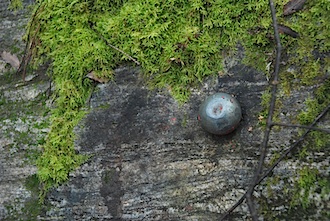
When I pass a large rock on the left, next to the Vuoksi river, I notice a small metal "button" on it. What on earth could this be?
The trail takes me to a dyke way which these days connects some small islands and allows you to cross to the other side of Mellonlahti bay. The pier with its four wooden tables is used for washing rugs when the water is somewhat warmer than now... like in the summer months. However, these days such washing places are being moved on the shore more and more, to prevent the fish getting soap in their eyes. Better for the environment that way. Otherwise, the tradition of scrubbing your rugs clean outdoors is simply great!
I arrive at the other side of the Mellonlahti bay and turn back to follow the nature trail. Vuoksi river runs on my right, and Mellonlahti bay, now separated from Vuoksi by the dyke road, is on the left. In Mellonlahti bay, fishing is forbidden, but I see a solitary fisherman on a small boat to my right.
On my return I turn to the left to the wooden pedestrian bridge which takes me to Kuukansaari which used to be a proper island before the dyke road was built. Unfortunately I haven't carried logs with me to make a campfire at the shelter (it's an absolute NO to take firewood from the forest!), so it's better to keep moving along the narrow, winding paths to get back to the nature trail on the other side of Kuukansaari.
The nature trail turns to the left and shows Mellonlahti bay in the bluish afternoon light, almost asleep. A man is turning his rowing boat upside down for the winter, and I go to him to ask if he needs help. - Oh no, I'll manage, he says, and shouts thanks for the offer when I turn away. Twenty seconds later I hear a thump. The boat has turned back to its original position. Oh well, I did offer...
On the right, a row of tall spruces at the top of the ridge guards the path. I climb up the trail, then take the wooden steps down to the shore and wonder why the arrows pointed this way. As I look into the shallow water, I notice continuously bursting bubbles here and there: tiny natural springs. The brook is nearly dry, but water comes from underground.

The path soon leaves the forest and meets an asphalt road. On the right, you can see Mellonmäki hill which is the end of the trail, so it is quite easy to find your way there. After crossing the road, the blue trail marks appear again, and the trail turns left before winding its way to the very top of Mellonmäki.
Mellonmäki is about 108 metres high, but you can climb even higher if you go up the wooden ski jump tower. The smoke in the distance comes from Svetogorsk, Russia - from one of the biggest paper mills in the whole country. I am indeed very, very close to the Russian border. Svetogorsk has a Finnish history; the town was originally called Enso (part of Jääski) and it was part of Finland until taken over by the Soviet Union in World War II.
Looking over the border area at Russia from here, I see only a huge, never-ending forest in late autumn colours. Seen from this ski-jump tower, it looks like a quiet neighbour. I feel the wind in my ears and take a stronger grip of the rail. Time to descend from the slightly swaying (or am I just imagining?) tower and the Mellonmäki hill back towards the town. The narrow path takes me down to the road and it's easy to figure out that by turning to the left I will easily get back to where I started, at Valtionhotelli Hotel and its park.
I am already very close to Valtionhotelli hotel when I see an square rock by the side of the road on the right.
As I step closer, I realise that it is an old boundary mark: the engravings say Ruokolahti and Joutseno. Ruokolahti is still an independent commune, but Joutseno is these days part of Lappeenranta city. Ruokolahti and Joutseno both contributed land to Imatra when the town was born in 1948 after World War II, on the ruins of the large Jääski commune which mostly remained on the eastern side of the border of Finland and Russia.  Glad to see this landmark is still there, reminding Imatra of its history.

For a November walk, this nature trail may not offer spectacular views and colours, but the route combines both nature and man-made landmarks and at least gives you a peek across the border to Russia.