Showing posts with label world heritage. Show all posts

Monday, 25 March 2013

Ylitornio: Panoramic Aavasaksa

Oh Aavasaksa beautiful! And thy sky so blue! Aavasaksa and the its neighbour Tornio River valley are among the 27 national attractions in Finland and the site has been famous for centuries, mostly because of Midnight Sun. The hilltop offers great views - also across the border to Sweden - so it is well worth a visit. I plan to take over the hilltop on snowshoes, but put them on only after entering the Aavasaksan kruununpuisto (Aavasaksa's Crown Park - the name dates back to the days when Finland was not yet a democracy). One of the marked routes on Aavasaksa will take me up, around the hilltop and back down to the holiday village.
I step on the pure, white snow and locate the marked Kruununkierros (Crown Tour) trail; more by the footprints of the previous walker than by the trail marks which are almost totally buried under the snow. I might even attempt to follow the trail without snowshoes but as they give me the liberty to step off the track, I prefer to wear snowshoes. Very soon I spot footprints, or hoof prints by some other creatures. And some fresh droppings. A flock of reindeer must have just passed by!
Aavasaksa hill is not very steep on this side. However, the gradual ascent soon takes me high enough to get a good view to the south although I am not even close to the hilltop. A sign by the path informs me that there were ancient trees here until Pierre Louis de Maupertuis and his expedition came to Aavasaksa in 1736-37 to conduct their measurements, having determined it a great place as a triangulation point when they were examining the shape of the Earth. To be able to see well enough to the next triangulation points, they needed an open view and thus demanded the trees to be cut down from the hilltop.
The wind has created interesting formations of snow around some pine trees which typically may grow to a funny, slightly curly shape in a place like this. However, the sun is doing its best to destroy the natural snow hut.
Aavasaksa's hilltop was never buried underwater like many of its neighbours; after the Ice Age was over and the ice started melting, the hilltop was an island in the ice-cold sea which reached 208 meters higher than the sea level is today. So...the waves were splashing against the rocks not too far from me. Down below is Tengeliö River which goes round Aavasaksa hill before it meets the great Tornio River. I walk a bit further - and over there the fantastic view opens to the north. If the sun is not hidden behind clouds at Midsummer, you simply can't miss it from this hilltop.
I look to my left and see a statue between the trees. Annikki Kariniemi (1913-84) was a Finnish author whose work focused on her native Lapland.
There are several marked trails that circle on Aavasaksa - the yellow one is called Sun Tour, the brown one Imperial Tour, the black one Crown Tour. The blue line marks a cross country skiing track. I step off the trail and climb to the top where the buildings are, among them the observation tower from where you get the best views. When I reach the tower, I hear that a flock of reindeer has indeed just passed the hill - did I see them? A close shave. Just their droppings.
After I brush away a bit of snow, the interesting looking caged rock turns out to be a memorial for Pierre Louis de Maupertuis and the expedition of L'Académie Française that came here in mid 18th century to do their measurements. The Swedish astronomer Anders Celsius - who we are to thank for the Celsius thermometer - was also part of this expedition. Based on his measurements along Tornio River, Maupertuis managed to prove that the Earth is flattened near the poles.
Maupertuis may have been the first to conduct such significant measurements atop Aavasaksa but about one hundred years later another astronomer Friedrich von Struve had the triangulation points marked permanently. Aavasaksa is part of the Struve Geodetic Arc which is on the Unesco World Heritage list, as one of the six protected such points in Finland. Struve was also measuring the shape of the earth and he came to Aavasaksa in 1845. The triangulation point is on the highest point of Aavasaksa, at 242 meters above sea level, which is right under the observation tower.
To my delight, the observation tower is open also in winter! The steps are inside the tower so you can climb up without being exposed to the wind.
From the observation tower the views are breathtaking on this sunny day which is so bright that my eyes almost hurt. Behind the Imperial Lodge the view extends across the Tornio River which marks the border between Finland and Sweden. So yes, on the other side of the river there are Swedish mountains.
Tourists and travellers have come to Aavasaksa to admire the views especially in the summer for centuries. One of the people who planned a visit to Aavasaksa as part of his trip to Ostrobothnia and Lapland, was Alexander II, Czar of Russia and Grand Duke of Finland. The Imperial Lodge was built in his honour in 1882 but unfortunately, the Czar never came here. Luckily, the building is still there and it has been restored.
The Imperial Lodge combines many different styles and different types of ornaments. The Lodge is only open in summer but this is nothing new; I am used to finding closed doors on my winter trips, especially now that the schools' winter holiday season is over.
So naturally it is not possible to shop in the Jugend style kiosk (1912) either.
I leave the hilltop and start the descent but instead of heading straight back to the marked trail, enjoy my freedom trail on the pure white snow. There is no fear of getting lost; I can focus on enjoying the sun, the view to Tornio River, the silence around me. Only occasionally do I hear a motor somewhere in the distance. 
Finally, I end up back on the Crown Trail and check out the shelter - very few logs left for making a fire but I'm quite happy without it now - before heading to the holiday village where I started from.
Goodbye to all the snow-covered trees and the gorgeous views of Aavasaksa!

Monday, 16 July 2012

Korsholm, Björköby: Bodvattnet nature trail

Whether you've experienced the Kvarken islands from the sea or not, a walk right next to Svedjehamn harbour at Björköby village is a delight. It may sound funny to do a walk on the mainland to experience the archipelago of the Kvarken,  one of UNESCO's World Heritage sites, but it's worth it.
It would be great to do the whole trail from Björkö to Panike but as these trails are a total surprise to me, only discovered on the spot, I opt for the 4-kilometre one round Bodvattnet, Bodvattnet runt. The trail returns conveniently back to where it starts from.
A short walk along the narrow road takes you to the marked trail which you can't miss anyway, thanks to the wooden gate. Nature trails aren't always in as good condition as this one!
Even if this may not be the height of the wild flower season, there is always something to look at right at your feet. Should carry a flower guidebook with me, I'm really bad with the names of the plants.
Arriving at the birch-dominated forest, I am surprised. As if it was spring, and the leaves were only about to come out; the birch leaves seem absolutely tiny. What is this? You'd expect the leaves to be pretty big in July and their colour ought to be a much deeper shade of green.
When I spot the small rowntrees by the side of the path, I stop to take a closer look. Poor things. There must be some pest insects about. Perhaps the damages in the trees are all caused by the same ones, which could explain why the birches look like they're not feeling well either.
Soon the trail arrives at Bodback where the Russian army began its unfortunate trip across the sea to Sweden in March 1809. A sign by the side of the road advertises historic guided walks which take you back to the events of those days.
Björkö's most important fishing port used to be located in Bodback. However, due to the annual rising of the land, the fishing port simply had to be moved to another place. When the fishing port here was at its busiest, there were more than 100 buildings for the fishermen on these shores. Only few of them remain today. 
The waters of Bodvattnet are now so shallow that they wouldn't allow passing with fishermen's boats. Some original, ancient fishermen's nets are hanging there, as if getting dry after a fishing trip.
Bodvattnet runt... round Bodvattnet. Even the name indicates that if you can walk round this former bay, it must have either lost its connection to the Gulf of Bothnia totally or there is one or more bridges for us walkers. I wonder how the fishermen felt when they saw the waters get shallower year by year at their home port; how could the sea do that to them, as if it was slowly walking away? However, they had no choice but to leave and follow the sea. And it wasn't the sea's fault anyway; their enemy would have been the rising land.
The nature trail, having begun wide as an avenue, turns into a rocky path that follows the Bodvattnet shore. The little fence is there to keep the sheep at bay. Their summer job is an easy one, a continuous eat all you can buffet, and thus taking good care of the scenery.
The pleasant path meanders through the trees under which there is an abundance of berries ripening - not ready just yet though. It could be a good year for cranberries!
Some of the birches along the trail seem to have chosen exactly the same favourite spot to grow on. How come they haven't realized that was plenty of good land available close by, and they could easily have grown up straight instead of crooked?
The numerous little white flowers that decorate the land are not at all familiar to me (later discovery: bunchberry or Swedish Cornel). Soon I arrive at a place which is perfect for a snack, if only you've come prepared: there is a picnic table and benches, plus firewood for making a fire, right by the sea and the sea buckthorns. Lovely!
The tiny wooden bridge reveals that this is where one of the most recent connections between the sea and Bodvattnet used to be. However, now the rocky bottom is completely dry.
Towards the end of the nature trail, there is a reward: the wooden Saltkaret observation tower. A climb up is definitely something not to be missed! Only a couple more steps...
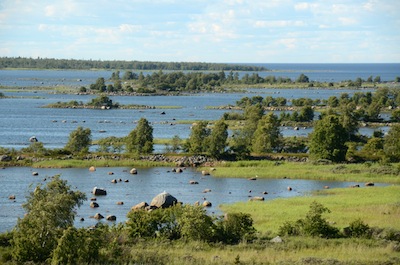
The views from the tower are fantastic.  The Kvarken is spotted by numerous islands, the number and sizes of which keep growing slowly. Somewhere there, on the other side of the Kvarken, there is Sweden, but before the Swedish isles for example Valsörarna (Valassaaret) islands that belong to Finland. I wonder how long it will take before the rocks that are now partly in water will be on totally dry land?
From this perspective it is much easier to get an idea of how the scenery keeps changing, with the narrow moraines that are all pointing the same way. Saltkaret is literally the top of Bodvattnet walk but I still recommend to walk the whole way, and not take a shortcut to the tower!

Saturday, 14 July 2012

Kvarken Archipelago, Valsörarna Nature Trail

Taking a walk at UNESCO World Heritage site at the Kvarken Archipelago at the Gulf of Bothnia, Finland, isn't actually that easy without a boat, but luckily I spot an advert for day cruises that include a walk along the nature trail at Valsörarna islands (Valassaaret in Finnish). There is hardly any wind and seven people have signed up in advance so we are in luck; the cruise is on. The experienced captain starts navigating us through the shallow, rocky waters and the moraines that are so typical of this area.
The journey from Svedjehamn harbour, Björköby village is an experience in itself. At the Kvarken, the land is continuously rising (greetings from the Ice Age!) - amounting to about 8 mm per year. It may not sound like much, but the islands are slowly growing together and once open bays are closing in. Our guide Roland Wiik notes that after ten year's time the boat won't be able to follow the same route anymore.
I watch the narrow islets that have been forming here and there. The Baltic Sea is giving us a smooth ride. What a glorious day! It is very hard to imagine that the Kvarken is still going through the strange transformation process that began thousands of years ago, and that eventually it will lead to Finland and Sweden being joined by land at the Kvarken area. However, that may take as long as about 2000 years...
There used to more separate islands at Valsörarna islands but some of them have already grown together. As our boat approaches the jetty at Ebbskär harbour, two beautiful cranes take off from the shore. The tiny harbour is these days deserted; the Coast Guard station was closed in 2009.
Our guide Roland Wiik is proud to say that Finland's oldest and largest private nature reserve was established at Valsörarna islands already in 1934. The nature trail (2.8 km) begins right next to the old Coast Guard station.
The symbol painted on the wall of a nearby building is a remnant from the first lifeboat station established at Valsörarna in 1904. However, despite the Kvarken being such a tricky area to navigate in, there is no longer a lifeboat station on the island. Saving costs, yes; saving lives...?
A small viper hides quickly when our group approaches its resting place. The small red house was originally built here for the "lifesavers" but these days it serves bird-watchers as a biological station. There is an abundance of different birds in the islands.
For the first part of the trail the vegetation is very low, consisting mostly of cranberries and heather. However, the trees will very quickly take over the land unless the traditional archipelago methods are used: in many islands, people used to burn the ground once in about every 40-50 years (to enable new growth on more fertile soil) or let sheep roam the land, eating whatever they could find. Either of those helped in making the land provide you with more food, such as wild berries.
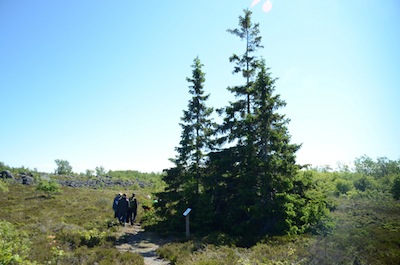
After a bunch of  birches and small aspens, we meet a group of fir trees. Our guide stops to show us that this is a family spruce.
A family tree? Yes indeed. The tallest spruce in the middle is Mummy, and her children, the baby spruces, have sprung up from the low-hanging branches that have first crawled on the ground and then started growing upwards. But they still haven't cut the cord with Mummy!
Further along, we take a side step to Käringsund which used to be a proper bay but over the years, as the land has risen, it is now a flada that is only linked to the sea by a narrow brook. As years go by and the connection is broken, it will eventually become a lake.
The rocky patches by the side of the nature trail indicate that the seashore used to be up there. The rowntree grows in the middle of some rocks that are laid out like a shelter for fishermen - which is what it used to be. Today, such shelters are made of logs. Wow, the rowntree is still in bloom although it is already July!
I walk up to the rocky monument which has a sad history. In March 1809, the Russian General Barclay de Tolly led his troops across the frozen Kvarken from Finland to Sweden and managed to conquer Umeå city, but was told to turn back. The trip was hard for his men in the freezing conditions and as a result, hundreds of the soldiers died on these islands. In 1930's the last remains of these soldiers were gathered under this pile of rocks.
We are now walking on a stone bridge that was built and used to connect the Ebbskär island with Storskär island - but that was back in the 19th century, during the construction work for the lighthouse... There is absolutely no water in sight anymore, and the two islands have grown together long ago.
Some wild white orchids grow among the low bushes. The forest type is once again changing. Oh no, I can hear more and more mosquitoes...
The grove feels like a mosquito heaven but I try to walk slowly and take in what I can of the absolutely beautiful surroundings. Waving my hands like mad, though. Go away, mosquitoes!
I breath in the gorgeous greens. It is as if it was spring again, the colours are simply magical. A paradise, except for our tiny friends that keep circling us for fresh blood.
Lunchtime! We are almost at the end of the tour, arriving at the bright red lighthouse and the former lighthouse keepers' dwellings. The original plan was to build the lighthouse at Ebbskär, where we just came from, but to build a lighthouse properly you need very solid ground, and this was nearest to finding a good foundation. Thus the road. I don't envy the workers who had to move the stuff here from the original building site on the other side of the islands.
Storskär lighthouse was completed in 1886 and the steel constructions were designed by no other than Henry-Lepaute engineering company in Paris, France. One of their next projects was a certain Eiffel tower in Paris.
Blades of cotton grass are swaying in the air, as if waving us goodbye. We walk to the shore to meet the boat and complete the nature trail feeling very happy. There is yet the boat ride to enjoy! And after this trip, if I happen to hear the shipping forecast on the Finnish radio, it will feel different because now I know exactly where these unique islands are and what they looked like in the summer of 2012. This is truly a place that will never look the same again!