Showing posts with label vaasa. Show all posts

Saturday, 14 July 2012

Kvarken Archipelago, Valsörarna Nature Trail

Taking a walk at UNESCO World Heritage site at the Kvarken Archipelago at the Gulf of Bothnia, Finland, isn't actually that easy without a boat, but luckily I spot an advert for day cruises that include a walk along the nature trail at Valsörarna islands (Valassaaret in Finnish). There is hardly any wind and seven people have signed up in advance so we are in luck; the cruise is on. The experienced captain starts navigating us through the shallow, rocky waters and the moraines that are so typical of this area.
The journey from Svedjehamn harbour, Björköby village is an experience in itself. At the Kvarken, the land is continuously rising (greetings from the Ice Age!) - amounting to about 8 mm per year. It may not sound like much, but the islands are slowly growing together and once open bays are closing in. Our guide Roland Wiik notes that after ten year's time the boat won't be able to follow the same route anymore.
I watch the narrow islets that have been forming here and there. The Baltic Sea is giving us a smooth ride. What a glorious day! It is very hard to imagine that the Kvarken is still going through the strange transformation process that began thousands of years ago, and that eventually it will lead to Finland and Sweden being joined by land at the Kvarken area. However, that may take as long as about 2000 years...
There used to more separate islands at Valsörarna islands but some of them have already grown together. As our boat approaches the jetty at Ebbskär harbour, two beautiful cranes take off from the shore. The tiny harbour is these days deserted; the Coast Guard station was closed in 2009.
Our guide Roland Wiik is proud to say that Finland's oldest and largest private nature reserve was established at Valsörarna islands already in 1934. The nature trail (2.8 km) begins right next to the old Coast Guard station.
The symbol painted on the wall of a nearby building is a remnant from the first lifeboat station established at Valsörarna in 1904. However, despite the Kvarken being such a tricky area to navigate in, there is no longer a lifeboat station on the island. Saving costs, yes; saving lives...?
A small viper hides quickly when our group approaches its resting place. The small red house was originally built here for the "lifesavers" but these days it serves bird-watchers as a biological station. There is an abundance of different birds in the islands.
For the first part of the trail the vegetation is very low, consisting mostly of cranberries and heather. However, the trees will very quickly take over the land unless the traditional archipelago methods are used: in many islands, people used to burn the ground once in about every 40-50 years (to enable new growth on more fertile soil) or let sheep roam the land, eating whatever they could find. Either of those helped in making the land provide you with more food, such as wild berries.
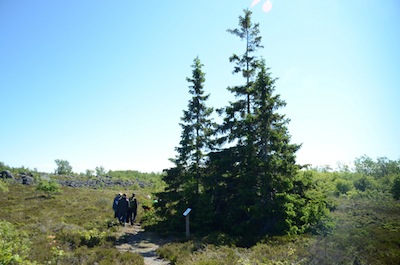
After a bunch of  birches and small aspens, we meet a group of fir trees. Our guide stops to show us that this is a family spruce.
A family tree? Yes indeed. The tallest spruce in the middle is Mummy, and her children, the baby spruces, have sprung up from the low-hanging branches that have first crawled on the ground and then started growing upwards. But they still haven't cut the cord with Mummy!
Further along, we take a side step to Käringsund which used to be a proper bay but over the years, as the land has risen, it is now a flada that is only linked to the sea by a narrow brook. As years go by and the connection is broken, it will eventually become a lake.
The rocky patches by the side of the nature trail indicate that the seashore used to be up there. The rowntree grows in the middle of some rocks that are laid out like a shelter for fishermen - which is what it used to be. Today, such shelters are made of logs. Wow, the rowntree is still in bloom although it is already July!
I walk up to the rocky monument which has a sad history. In March 1809, the Russian General Barclay de Tolly led his troops across the frozen Kvarken from Finland to Sweden and managed to conquer Umeå city, but was told to turn back. The trip was hard for his men in the freezing conditions and as a result, hundreds of the soldiers died on these islands. In 1930's the last remains of these soldiers were gathered under this pile of rocks.
We are now walking on a stone bridge that was built and used to connect the Ebbskär island with Storskär island - but that was back in the 19th century, during the construction work for the lighthouse... There is absolutely no water in sight anymore, and the two islands have grown together long ago.
Some wild white orchids grow among the low bushes. The forest type is once again changing. Oh no, I can hear more and more mosquitoes...
The grove feels like a mosquito heaven but I try to walk slowly and take in what I can of the absolutely beautiful surroundings. Waving my hands like mad, though. Go away, mosquitoes!
I breath in the gorgeous greens. It is as if it was spring again, the colours are simply magical. A paradise, except for our tiny friends that keep circling us for fresh blood.
Lunchtime! We are almost at the end of the tour, arriving at the bright red lighthouse and the former lighthouse keepers' dwellings. The original plan was to build the lighthouse at Ebbskär, where we just came from, but to build a lighthouse properly you need very solid ground, and this was nearest to finding a good foundation. Thus the road. I don't envy the workers who had to move the stuff here from the original building site on the other side of the islands.
Storskär lighthouse was completed in 1886 and the steel constructions were designed by no other than Henry-Lepaute engineering company in Paris, France. One of their next projects was a certain Eiffel tower in Paris.
Blades of cotton grass are swaying in the air, as if waving us goodbye. We walk to the shore to meet the boat and complete the nature trail feeling very happy. There is yet the boat ride to enjoy! And after this trip, if I happen to hear the shipping forecast on the Finnish radio, it will feel different because now I know exactly where these unique islands are and what they looked like in the summer of 2012. This is truly a place that will never look the same again!

Wednesday, 11 July 2012

Vaasa: sights and a walk by the seashore

Vaasa is a city of lovely esplanades, thanks to the Swedish architect Carl Axel Setterberg who was commissioned with drawing the city plan in mid-19th century after the old Vaasa had burned down in 1852. Thus, a pedestrian may choose to walk on a regular sidewalk on either side of the street or in the middle of it.

The two Mobitours, guided by a cellphone, also take you for a walk along the esplanades. However, I complement the cellphone guide with a printed map; somehow it feels nicer to see the whole route, not just what is the next stop on the cellphone screen.
Sights and a Walk by the Seashore is about 3.5 kilometres long and just like the shorter Mobitour walk, it begins by the church at Kirkkopuisto (Church Park). I have heard the church story before so I cross the street to the see the Empire style Church Pharmacy, Kirkkoapteekki (1860). The writer and poet Zacharias Topelius is engrossed in reading a fairytale for the children. 
The granite building next door was built for the Bank of Finland (architect: Johan Sirén) which may explain the artistic bars on the ground floor windows. The other decorations include granite reliefs.
I turn right to the alley surrounded by lime trees before the tall yellow Jugend style house. Hope also other residents plant some flowers on their balconies! After the little detour I'm again back at Kirkkopuistikko street, heading for Arbis and Wasa Teater.
The Swedish theater building of this bilingual city is nothing fancy, but there are some details in the next buildings on the way, like the simple doors of the Evangelical Lutheran Prayer House or the grey granite decorations on the beautiful pink Jugend style house that the Mobitour doesn't name.
In the old days, there used to be public wells in the esplanades but nowadays you have to carry your own drinking water with you. If only these wells were still in operation, it would be great to be able to fill your water bottle here.
I don't take the shortest route to Ostrobothnian Museum but make a detour via the wooden houses close to the shore. Pikkukatu street is indeed a little street! As I'm walking on a Monday there is no hope of getting in so I miss also the Terranova Kvarken Nature Centre which is devoted to the nearby archipelago, Kvarken, included in UNESCO's World Heritage site list.
There are some odd-looking laminated sheets hanging in the yard in front of the museum. A work of art, apparently. Nothing like a spider's web so what is it?
Then I notice a tiny dragonfly statue on a fairly high pedestal, and again two more; however, the statue in the middle is unfortunately missing. Cordulia aenea, Calopteryx virgo anc Aeschna grandis form Cyglys, a work of art by Stefan Lindfors, but it takes a while until I realise what the whole thing is about. The artwork must look stunning when the spotlights are illuminated at night and shadows start their play. Only it doesn't get too dark here at this time of the year!
I walk round the old Vaasa Steam Mill (Vaasan Höyrymylly) and finally arrive at the seashore. It is easy to forget that Vaasa is a seaside town if you remain in the city centre! There is no longer cereal or flour in the air because the buildings now serve Åbo Akademi university students instead, and the place is these days called Academill. I hope the thick walls can keep the fierce wind away in the winter; right now this is a perfect place for a walk.
The young oak tree in the corner of the now academic park is no ordinary tree. It was planted in 2006 in celebration of Vaasa's 400th anniversary by the bank Handelsbanken and the tree stands for Growth and Knowledge.
I return from the shore back to Rantakatu street and its old houses. The red brick building is reserved for the administrative office of Åbo Akademi, a Swedish language university which has a branch also here in Vaasa. Originally, the building was the residence of A. A. Lévon, the founder of Vaasa Steam Mill. At least the main entrance doors are well protected by the decorative cast iron shapes! But who is that guy in the middle - is it Mr Lévon himself?
A peek into the back yard of the administrative building reveals a funny bright red piece of art, apparently constructed of tractor seats. At least that's my guess. Is it a funnel of knowledge, or perhaps a flower? Or a horn of plenty?
Interesting houses continue on the sleepy Rantakatu street, with hardly any cars going by. This is a lazy afternoon indeed. A side door of Svenska Klubben (Swedish Club) says Odd Fellow. A strange guy? Interesting...  There is no entry right now to Setterberg Park which is under renovation, but the Mobitour guide leads me back to the large park by the sea. Also, time for lunch: Strampen serves excellent perch that is fished locally.
After lunch I continue down to the Kuntsi Museum of Modern Art but of course I only get to see its exterior, thanks to it being Monday. For me, this building, a former customs storehouse, is more pleasing to the eye than the magnificent red brick of Hovioikeus (Court of Appeal) a bit further at the Harbour Park.
The footpath by the sea leads me to the other side of the County Prison (nicknamed Vaasa Castle), safely behind massive brick walls. The basin in front of it is named after the prison (vankila) but the boats are free to go any time. A boardwalk leads to the small island in behind the basin for a more open view to the sea.
The yellow sedums are in bloom by the rocks. I walk round the tiny island. If only I hadn't just had lunch and I had a picnic basket with me; this would be the perfect spot.
On a lamp post by the boardwalk I encounter a mysterious sign but quickly recollect that this must stand for Vaasan Marssi, an annual walking event held at Vaasa in early August. The event is no race but it gathers together walking enthusiasts, and not only from Finland. There are walks of different length available.
My route takes me slightly uphill, to the fairly large old Barracks area that dates to the 1880's. It is great that so many of the wooden buildings are still intact. The Main Guard used to be in building marked with blue and white stripes.
The only remaining soldiers at the Barracks are now somewhat rusty, and I suspect that they are more than mostly harmless. They are actually guarding Kenraali Wasa Hostel which is located in an old military hospital building. I turn to head towards the Orthodox Church which is on the other side of the barracks square.
The entry to the Fria Kristliga Folkhögskolan building is quite stunning but I spot some rotten wood on the terrace beneath. Hope someone starts renovations soon! The lawn around the Orthodox Church looks very welcoming whereas the church doors are locked, as usual. Oh well, I'm used to that. Just keep going.
Next, I reach the statue erected for Carl Axel Setterberg; no wonder the city plan is also engraved in his memorial. Good work! Finnish towns are not usually this spacious; a typical town has pretty narrow streets whereas here you can really experience space. I know the walk isn't officially over yet, but I feel that I've almost had an overdose of beautiful buildings, parks and details for today...
There are a couple more old buildings ahead before I will call it a day. Last stop: the Water Tower. Locked. If it hadn't been, I'm sure I would have made the final effort and climbed up to get a full view of Vaasa and the sea.

I've just completed my second Mobitour in Vaasa, and but find that I've mostly clicked Next sight or Information links on the screen and haven't bothered to listen to the audio guide. It feels easier to walk with a printed map, and personally, I prefer a real person as a guide. You can't ask your cellphone any questions just like that (googling is not exactly the same thing) and you miss out great stories that a real person can tell. However, without the Mobitour guide, I wouldn't have done such an extensive sightseeing walk around town!
Finally, I take a left turn on Raastuvankatu street. What are the signs on that building? Kävely and käveleminen mean walking... Walking is one of the most important skills for an independent life. Quite right. The place, Kävelykioski (Walking Kiosk) gives training and guidance especially for older people who need to strengthen or regain their ability to walk. An interesting concept! It is so easy to take the ability to walk for granted.

Thank you Vaasa, let's keep on walking!

Monday, 9 July 2012

Vaasa: A glance at local history

I step into the tourist information kiosk at the market place in Vaasa. I know Vaasa city has published some walking guides but they are not available here; need to visit the Raastuvankatu tourist information for more information. *However, if you don't know Finnish or Swedish language, you can find most information about walks and hikes in Vaasa in English online only, not in print. Lucky me! I can also benefit from the excellent printed brochures and their maps. After the tourist office, I stop at the neighbouring building, House of crafts Loftet to decide where to head next. Someone has marked Loftet with a pretty knit graffiti :)
Loftet building dates back to 1860 and there is a handicraft shop in addition to the cosy café Konsulinnan kahvihuone (The Consul's Wife's Coffee Room) which has an excellent choice of teas available. I can feel the eyes of the Madame herself, Tulla Whittington-Moé as well as those of her sons Dick ja Cyril, on me while I sip my tea. 
In this charming old building there are many fine details, from the decorated glass cabinet by the window to the  neat woodwork. Glancing at the books on the shelves, I'm not surprised to see Jane Austen's Pride and Prejudice there. I can well imagine someone reading her novels here.
There are beautiful details in the next room as well. Just look above to the ceiling where there are classical, delicate female profiles as well as partly faded ornaments. In the room itself there is also something more modern to see right now: Tina Nylund has created fantastic, unique dresses (90 % recycled material such as old men's shirts) - which are on display together with stylish photographs of each dress.
After careful consideration, I choose my walk. Vaasa offers something I haven't yet experienced in Finland: Mobitour. There are two "personal guides" available for walks (in English, Swedish and Finnish) and each can be followed with a cell phone, provided that you download the Upcode onto your phone with the phone's Internet browser first. Just note the data transfer fees during the walk! You can both follow the route with your cell phone and read or listen to explanations at the marked stops, as well as see some photos. The code is usually visible also at the marked stops.
I choose to do the short walk first. The walk titled A glance at Vaasa's history begins at the lovely Kirkkopuisto (Church Park) and after a little negotiation with my cell phone, I start listening to the introduction to the church itself. Unfortunately the doors to the church are closed today and I miss the paintings, one of which was painted by Finnish master painter Albert Edelfelt.  The next stop is at the Sea pilots' statue, Luotsipatsas at the very same park. Oh no, the Mobitour commentary worked so well by the church, but it keeps stopping here. Better read the text instead.
After leaving the City hall, I skip Loftet (been there already!) and walk to Hovioikeudenpuistikko street on the corner of which there is quite a jewel: Kurtenia House.
The Jugend style is rich with details, starting from the doors and doorways. A crowned eagle is guarding one of the doors, but in the corner entrance there are lizard-like fantasy creatures on the oak doors. If you are looking for Brasilian Honorary Consulare, this is your door!
I hesitate only for a second before stepping in through the corner entrance which leads me to Il Banco restaurant. The name is appropriate because there used to be a bank right here, but what's more, there is still a bank as well. Ålandsbanken just happens to be behind the restaurant... Just keep walking through the glass doors to the magnificent bank hall with its stained glass ceiling!
Besides the beautiful ceiling, there are lots of fine details on the walls and ceiling above. Unfortunately I don't have any bank business to take care of, so better not linger there too long...
It would be nice to stop here for lunch to see some more of this place, perhaps next time! They really knew how to make a pretty entrance back in early 1900.
After I leave Kurtenia, I enter a wide pedestrian street which is decorated here and there by artwork. The statue of this couple taking a walk (Erkki Kannosto, 2006) is for some reason called Varjoja metsässä (Shadows in the forest) although there are not too many trees right here... I'd rather rename this Walkers in the forest.
The lamp posts designed especially for the pedestrian street are great! They are less than 1 metre tall and resemble lighthouses. It must be a cute sight in the evening (although at this time of the year, there are hardly any dark evenings!).
When I reach the market place, I notice I'm standing on slabs that list Vaasa's twin cities around the world. Morogoro, Tanzania, is 8,000 km from here, the German twin towns Kiel and Schwer less than 2,000 km away... So I'd better pay more attention to the blue signs above which include more tolerable distances for someone on foot. What does Mobitour say? Right behind me there is the great Hartman Business Palace with its grey granite statues. Wow!
Next, I walk diagonally across the market place and ignore one of Vaasa's busy shopping areas, Rewell Center which was named after the Vaasa born architect Viljo Revell. Unfortunately I'm not a great fan of his, even if he designed also the Toronto City Hall... Therefore, I'm happier entering Vaasa's market hall which has kept something from the old days although at first it seems that perhaps the stained glass could be all there is left...
As it is, you don't first meet this type of traditional style stalls when entering the market hall from Vaasanpuistikko street! It is only after navigating through the clothes shop that you find the 'real' market hall with its cafés and delicacies. The sign at stall number 60 is mysterious as it says Ostrobothnia Museum. I wonder if the museum used to have its own stall there...
After the market hall stop, there are only two more official sights to see on this Mobitour to local history. I take the Vaasanpuistikko street towards the railway station (the very last stop) and stop on the way at the classical style hotel Astor. However, I wish there had been a mention of the Wasa Yllevarufabrik (literally: Vaasa Woollen Objects Factory) which I pass on the way. What is the story of this red brick building?


Mobitour?

I think it is great that Vaasa city offers a cellphone guided tour - never been on one before. A Mobitour enables you to walk with a "guide" at your own pace and you can choose whether to read more or listen to the commentary about the places you're passing. However, the application could perhaps be somewhat improved...

Personally, even though really not rushing through the route, I was getting somewhat impatient with the continuous clicking and especially zooming in on every other screen to be able to click the right link or to move forward. So... I ended up using a printed version of the map to lead me to the next place and used only the commentaries or texts of the Mobitour guide to learn about the places.