Thursday, 4 April 2013

Tornio: Nivavaara hill

Karunki, Lapland, by Tornio River and E8 road. Close to a roadside car park there is a black sign Näköalapolku (Panorama Path). We cross the railroad tracks and wonder should we walk straight on or turn left. We keep on walking straight uphill, with the sun behind us, until I realize the road is turning the wrong way, towards the right.
Guess we missed the panorama path but that's no problem; we're well equipped. A quick check of the map on the cellphone - and it's snowshoe time! We will make our own trail to the top of Nivavaara hill. If we manage to find it, that is.
The shadows are creating new shapes on the crisp, windswept snow.
It is totally quiet around us but we are not exactly making a lot of noise. However, the Black Grouse (if that's what it was) manages to hear us approach and takes off to the top of a nearby tree, leaving a snow angel behind him or her.
We march on with our snowshoes and try to keep going in the right direction. It isn't exactly easy because the land rises very gently and there are quite a few trees; perhaps that's a bit higher, and that...As if it were hard to find a hilltop!
This piece of grey wood is what is left of an old tree. A work of art in itself, and probably untouched by human hands. Even mine. It feels good to choose exactly where to go instead of following cross country skiing tracks or a ready made path, even if that would be easier. After a while we however meet snowmobile tracks but that's ok; it seems we're still heading in the right direction.
And here we are: on the top of Nivavaara hill where there are some signs of humans in the form of masts and even a little cottage, albeit a deserted one. Down below is the Tornio River thanks to which it is very easy to not get lost - you only have to keep it on your left!
My guess is that somewhere under this pile of snow there are the remains of an old triangulation tower so this is probably the very top of Nivavaara hill: 124.4 meters above sea level and a guaranteed lookout spot. Nivavaara was visited also by Pierre Louis de Maupertuis in 1736 when this French astronomer and mathematician and his team were conducting their measurements to confirm the shape of the earth. Back then they could see Tornio church tower in the south as well as Aavasaksa hilltop in the north.
Either the scientists' eyesight was far better than mine or they must have carried a telescope with them. I really can't spot Tornio, looking south. It is far too bright... Anyway, I am quite happy with just enjoying the fabulous view from the top of the hill; a true panorama. How about a cup of tea from a flask? Yes, please!

Apparently there is a place where you can make a fire somewhere quite near us but we don't bother to look for it seriously. No need. From here we simply need to choose our own way down as we can't miss the road which runs parallel to the Tornio River. There are not too many footprints on the snow, not even by animals...
We meander downhill through the woods, again ignoring the 'official' trail that must be somewhere close by, under the snow. Soon we arrive among young pines among which there is something taller. It really is a single pine tree but from the distance, counting the tree tops, you could think there are four growing extremely close to each other! No wonder they let it grow... Hope it's gonna stay there for many years to come.

Monday, 25 March 2013

Ylitornio: Panoramic Aavasaksa

Oh Aavasaksa beautiful! And thy sky so blue! Aavasaksa and the its neighbour Tornio River valley are among the 27 national attractions in Finland and the site has been famous for centuries, mostly because of Midnight Sun. The hilltop offers great views - also across the border to Sweden - so it is well worth a visit. I plan to take over the hilltop on snowshoes, but put them on only after entering the Aavasaksan kruununpuisto (Aavasaksa's Crown Park - the name dates back to the days when Finland was not yet a democracy). One of the marked routes on Aavasaksa will take me up, around the hilltop and back down to the holiday village.
I step on the pure, white snow and locate the marked Kruununkierros (Crown Tour) trail; more by the footprints of the previous walker than by the trail marks which are almost totally buried under the snow. I might even attempt to follow the trail without snowshoes but as they give me the liberty to step off the track, I prefer to wear snowshoes. Very soon I spot footprints, or hoof prints by some other creatures. And some fresh droppings. A flock of reindeer must have just passed by!
Aavasaksa hill is not very steep on this side. However, the gradual ascent soon takes me high enough to get a good view to the south although I am not even close to the hilltop. A sign by the path informs me that there were ancient trees here until Pierre Louis de Maupertuis and his expedition came to Aavasaksa in 1736-37 to conduct their measurements, having determined it a great place as a triangulation point when they were examining the shape of the Earth. To be able to see well enough to the next triangulation points, they needed an open view and thus demanded the trees to be cut down from the hilltop.
The wind has created interesting formations of snow around some pine trees which typically may grow to a funny, slightly curly shape in a place like this. However, the sun is doing its best to destroy the natural snow hut.
Aavasaksa's hilltop was never buried underwater like many of its neighbours; after the Ice Age was over and the ice started melting, the hilltop was an island in the ice-cold sea which reached 208 meters higher than the sea level is today. So...the waves were splashing against the rocks not too far from me. Down below is Tengeliö River which goes round Aavasaksa hill before it meets the great Tornio River. I walk a bit further - and over there the fantastic view opens to the north. If the sun is not hidden behind clouds at Midsummer, you simply can't miss it from this hilltop.
I look to my left and see a statue between the trees. Annikki Kariniemi (1913-84) was a Finnish author whose work focused on her native Lapland.
There are several marked trails that circle on Aavasaksa - the yellow one is called Sun Tour, the brown one Imperial Tour, the black one Crown Tour. The blue line marks a cross country skiing track. I step off the trail and climb to the top where the buildings are, among them the observation tower from where you get the best views. When I reach the tower, I hear that a flock of reindeer has indeed just passed the hill - did I see them? A close shave. Just their droppings.
After I brush away a bit of snow, the interesting looking caged rock turns out to be a memorial for Pierre Louis de Maupertuis and the expedition of L'Académie Française that came here in mid 18th century to do their measurements. The Swedish astronomer Anders Celsius - who we are to thank for the Celsius thermometer - was also part of this expedition. Based on his measurements along Tornio River, Maupertuis managed to prove that the Earth is flattened near the poles.
Maupertuis may have been the first to conduct such significant measurements atop Aavasaksa but about one hundred years later another astronomer Friedrich von Struve had the triangulation points marked permanently. Aavasaksa is part of the Struve Geodetic Arc which is on the Unesco World Heritage list, as one of the six protected such points in Finland. Struve was also measuring the shape of the earth and he came to Aavasaksa in 1845. The triangulation point is on the highest point of Aavasaksa, at 242 meters above sea level, which is right under the observation tower.
To my delight, the observation tower is open also in winter! The steps are inside the tower so you can climb up without being exposed to the wind.
From the observation tower the views are breathtaking on this sunny day which is so bright that my eyes almost hurt. Behind the Imperial Lodge the view extends across the Tornio River which marks the border between Finland and Sweden. So yes, on the other side of the river there are Swedish mountains.
Tourists and travellers have come to Aavasaksa to admire the views especially in the summer for centuries. One of the people who planned a visit to Aavasaksa as part of his trip to Ostrobothnia and Lapland, was Alexander II, Czar of Russia and Grand Duke of Finland. The Imperial Lodge was built in his honour in 1882 but unfortunately, the Czar never came here. Luckily, the building is still there and it has been restored.
The Imperial Lodge combines many different styles and different types of ornaments. The Lodge is only open in summer but this is nothing new; I am used to finding closed doors on my winter trips, especially now that the schools' winter holiday season is over.
So naturally it is not possible to shop in the Jugend style kiosk (1912) either.
I leave the hilltop and start the descent but instead of heading straight back to the marked trail, enjoy my freedom trail on the pure white snow. There is no fear of getting lost; I can focus on enjoying the sun, the view to Tornio River, the silence around me. Only occasionally do I hear a motor somewhere in the distance. 
Finally, I end up back on the Crown Trail and check out the shelter - very few logs left for making a fire but I'm quite happy without it now - before heading to the holiday village where I started from.
Goodbye to all the snow-covered trees and the gorgeous views of Aavasaksa!

Thursday, 21 March 2013

Kemi: Fantasy SnowCastle

I'm dazzled. There is so much light! The sun is so bright and the sky so blue - this is Kemi, Finland, and the SnowCastle. This SnowCastle hasn't been built by children; it was sculpted by professionals. The snow castle tradition goes back quite a few years: this is the 18th consecutive snow castle built here. I walk along the frozen seashore towards the monstrous entrance to this winter landmark of Kemi.
Once inside the snow castle, and especially in the SnowChapel, time stands still. The green light behind the altar is soothing, there are a couple of lit candles to which I add mine. The miniature ship is something that is typically decorating the churches and chapels in the coast and archipelago of Finland.
There are clear blocks of ice - I wonder if they are pieces of ice from the Gulf of Bothnia - at the end of chapel benches. Very simple artwork. Some couples get married in the chapel of the SnowCastle every year. The atmostphere in such events must be both pretty cool and pretty warm!
Right next door to the chapel, there is a hall where you can sit down for a hot or cold drink by long tables made of solid ice. If you fall short of conversation topics, just have a look around you - there's plenty to watch and talk about!
Like the fantastic creatures around you, standing on the floor,  or sticking to the ceiling. The theme of the SnowCastle 2013 is Fantasy. 
There are ethereal maidens, fantastic animals but also a huge, gentle looking monster. Who's got his eyes glued to a lovely young ice maiden.
However, the Ice Maiden doesn't wink an eye but stays cool and keeps her pose.
I walk from one hall to another, moving from one atmosphere to another. In the Space Gallery there is an eerie blue light, as if it were night time, there are stars and planets in the sky. And some birds. Silent, but angry.
If it weren't such a bright day and if it were much later, I might feel tempted to stay on and spend a night in the SnowCastle, lie down on the furs
and fall asleep in the snow hotel room, under the snow fresco with a kid riding on a polar bear...
But no! I want to get back to the sunlight! On my way out, I pass quite a few gorgeous works of art: more sculptures made of ice or snow, on every room or hall. Hello, ice penguins! How are you doing, Mr Snow Fox? Oh, you just pulled a snow rabbit out of a hat!
At this time of the day, there are no live performances on the outdoor stage so I head up to the top of the building to get a view of Kemi seashore. All frozen, of course, and the Gulf of Bothnia is all white, with quite a few people either walking or cross country skiing on the ice. What a great view and a great snow castle -  Kemi SnowCastle was definitely worth a visit!

Sunday, 17 March 2013

Jämsä: Icy Synninlukko gorge

There are Paths of Sin (Synninpolku in Finnish) but there is also a Lock of Sin - or at least that is the literal translation of Synninlukko which is the name of a gorge in Jämsä, south of Jyväskylä in Central Finland. Finding the place isn't too easy - not least because the snow has covered some of the signs that are desperately trying to guide visitors there. Luckily, I've got my reliable snowshoes with me so it is easy to cover the distance between the road and the gorge; it has been a while since the previous visitor walked here but his or her footprints are still visible. So are those of the hares and foxes.

If Synninlukko isn't too easy to find, it may have been a blessing at some point. In the old days, the gorge was known as a hiding place (apparently not everyone knew it even then!) but the name may be a variation of some words in the local dialect. 'Lukko' (literally 'a lock') means a gorge in the local dialect and 'synnin ('of lock') refers to birth ('synnyin-', 'syntymä') and according to one story, someone was actually born here. Who knows.
I cross a small wooden bridge and follow the previous visitor's footprints slightly towards the left to locate the gorge. There are no signs and since the path is hidden beneath the snow, I sincerely thank the person who came here before me! Soon I find myself surrounded by the tall rocks of the gorge which is about 50 meters wide.
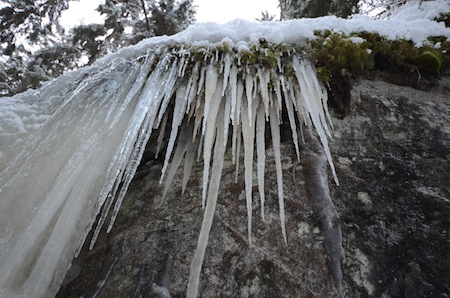
There are huge blocks of ice hanging down from the rocks as well as sharp icicles on my left. The gorge isn't huge but I think small is beautiful.
Come to think of it, the rocks are quite tall and steep enough for me. I walk along the bottom of the gorge, step closer to the rocks, feel the ice with my fingers, check the colour and shade of the ice and the patterns in the frost.
There is plenty of ice in different colours; somewhere the icicles are tinted with blue, somewhere else with brown.
As it turns out, Synninlukko gorge is an excellent place for exploring different kinds of ice! Although my visit takes place fairly early - it is not really spring yet - there seems to be loads of ice everywhere.
It is as if there was a huge ice monster on the top of the cliff who is gnarling and baring his teeth to me! Synninlukko gorge will surely be even more handsome as the spring advances.
Finally, I reach the end of the gorge and climb up to the top of the cliff, to take a snowshoe walk there. There is a small sign that announces I'm at a nature reserve but no further guidance. Should I walk further or turn back? However, as the sunlight seems to be starting to fade and the sky is slowly exposing a shade of pink, it is a clear message to me that I'd better head back.

This gorge may well be at its best in the winter but I'm already wondering what it is like in here in the summer!

Thursday, 7 March 2013

Helsinki: National Library

The National Library of Finland, Kansalliskirjasto. It sounds so grand. The building is not the hugest in Finland or in Helsinki, but it has certain grandeur - just look up towards the ceiling once you've left your coat in the cloakroom and your bag in a locker and entered the main hall. This is a home to important books: Finland's printed national heritage. It is the oldest and largest scholarly library in Finland. Thus, well worthy of the gorgeous cupola above my head. Why on earth have I not visited this place before?
If you are into books, you could easily do a bookish toure in Helsinki: visit interesting libraries and bookshops. You don't need to be intent on buying or even reading to go for a stroll in such places. Besides a historic library such as the National Library (built in 1840-45), situated right next to Senate Square you could stop at more modern ones (the newest is within a stone's throw from this library). Being a book lover, I can't help admiring places like this. I wonder what a... Kindle, well, "room" would like in comparison...
The South Hall reading room (Eteläinen lukusali) is very inviting. I wish I had time to grab a book, sit down and read for a while like some other visitors have done.
I walk along the gallery and stop to read at the titles. Valtiopäivät 1888. That is Diet 1888 and these are the diaries from those days when Finland wasn't yet independent (that had to wait until 1917) but as an autonomous Grand Duchy, it was allowed certain rights such as its own constitution, legislation and a Diet. In those days, Finland wasn't yet as democratic as today;  it was only the nobles, clergy, burghers and peasants that could send their male representatives to Säätyvaltiopäivät.
I pick up a copy and open it at random. Mr Iivonen of the clergy has made a speech about inn-keeping and feels that peasants understand better than the clergy what is fair for inn-keepers (inns were maintained by peasant class). Free translation: They have brought all kinds of numbers to prove otherwise, but numbers can always be used to defend such things that are not good. The world hasn't changed one bit.
I browse the library and arrive at Rotunda, the annexe that was built in 1902-06. The huge poster that is hanging there tells about the exhibition that was opened only recently for poet Saima Harmaja (1913-1937) who was born exactly 100 years ago.
Unfortunately she had poor health and died so young; miss Harmaja only saw three of her well-acclaimed poetry books published before her death and her fourth book was published posthumously. Very little of Saima Harmaja's work has been translated to other languages from Finnish.
I climb up to the 6th floor - what a great shape this hall has!
Most visitors to Senate Square in Helsinki probably see the Helsinki Cathedral facade only from the square below (unless they bother to climb up the steps to pay a visit inside). When I step out of the National Library, I face the main entrance to the Cathedral on Unioninkatu street. Daylight is already fading away and it is time to turn on the lights for the night.