Showing posts with label artistic walk. Show all posts

Saturday, 6 October 2012

Jyväskylä Culture Trail 2012

Whether hard rain's gonna fall or not, I'm going out; Kulttuurisuunnistus is the annual Culture Trail event in Jyväskylä, with different checkpoints scattered around town, to be explored at your own pace and by choosing your own route. The checkpoints change somewhat each year but always include stops at museums and art galleries along the way. This year it is possible to visit 14 different places on the afternoon of 30 Sep. However, the weather may prove to be too wet for some... When I enter the city centre, there are only few walkers and cyclists about. It is better to focus on the beautiful colours of the fallen leaves than the raindrops that keep falling on my head...
For some reason I end up choosing the furthest checkpoint as my first destination: Vaajakoski is about 8 km from the city centre. Perhaps not the wisest choice on a rainy day, but who cares... The river Tourujoki flows slowly, with the surrounding trees dropping their yellow leaves to the water at equally relaxed pace. At least I get to enjoy the lakeside footpath for many kilometers to start with.
The grey clouds hang above the skyline of Jyväskylä and the lake Jyväsjärvi. When you look at he view is as if the reeds were the only spot of colour today. On the other side of the footpath, I suddenly hear the Halssila church bells chime 12 times through the hum of the motorway. It is the official starting time of the Cultural Trail event but I had to make an early start because of wanting to do it on foot between 12 and 4 pm - and even then I may not be able to visit many places because of choosing the longest possible route.
Leaving lake Jyväsjärvi behind, I ascend from Rauhalahti to Vaajakoskentie road, passing beneath two roads. Young artists have been at work, probably without being commissioned by the city of Jyväskylä. I wonder what the fierce looking fish is dreaming of.
Step by step, puddle by puddle I march on. The sidewalk is right next to the road for most of the way which means that I have to be on the lookout for cars - the road has had its share of rain as well. Knowing that I'll need to cover some distance within a limited time, and having to keep the raincoat hood on for most of the time, this will be a different type of walk to my usual ones: my eyes will most likely catch fewer new things while I'm on the move. It means more time for thinking, of course. I meet an older man who is walking towards me, without a raincoat or umbrella. He is asking how many kilometres is it to Viherlandia Garden Centre - in English. Three, perhaps a bit more, I venture, and wish it stopped raining for a while, if only just for him.
Oh where art thou, Resiina Arts & Crafts shop? I walk past the roundabout at Vaajakoski, through the underpass with the bright coloured graffiti from 2011. I take shelter under a tree and open the wrinkled Culture Trail map, published by the local newspaper Keskisuomalainen, and wonder how I'll manage to keep it dry enough all day. The map is far from detailed and I have to turn to my cellphone to find the address and the exact location of Checkpoint 14. OK, it is on the other side of the railroad tracks...
Walking back towards Vaajakoski center, I again get a good look at the paintings on the underpass walls. This is probably the only place where I can catch a rainbow today!
Resiina is located at Asematie (asema = station, tie = road). The wooden building used to be Vaajakoski railway station but passengers haven't been seen stepping on or off trains here for many years. If I remember correctly, the village was originally called Haapakoski but when the railroad was built in the early 20th century, the station was renamed Vaajakoski because another station called Haapakoski already existed in Eastern Finland. I step inside the Arts & Crafts shop Resiina which I've never visited before. There are lots of local handmade products for sale, ranging from jewellery, ceramics, toys and clothes to art. I open my map, get a stamp at number 14 and answer a question that relates to the place. Those who have visited at least 4 Culture Trail stops this afternoon can enter a lucky draw to win culture related prizes.
Resiina offers a chance to walks on stilts on the yard but prefer my own feet... After this, I'll simply walk the +8 kilometres back to Jyväskylä city centre to visit the next checkpoint. Unfortunately the Panda licorice and chocolate factory store next door is closed today so I can't get any fresh local candy from there, to keep me going... However, honouring local produce, I get some Panda licorice from a grocery store on the way. The rain has stopped for now and I enjoy walking without the hood on for a while. I know I would be able to visit more Culture Trail places if I caught a bus to town but why not just keep walking, it's not that far anyway...
Unfortunately the rain returns slightly fiercer. When I arrive at Tourula, there is a choice of visiting an Arts & Crafts Centre for the young or continuing my walk straight to the harbour, to do a walking fitness test. Guess what? I opt for the arts. It means stepping inside from the rain for a while. The door handle to Taitokeskus is decorated with a cool knit graffiti, made of Granny Squares. Target number two for me.
The Arts & Crafts centre is surprisingly quiet, compared to what I've seen it on other such occasions. The rain must be the one to blame, keeping most people within a shorter distance to the city centre. I do a short tour inside and step back into the rain, heading for Veturitallit.
Veturitallit (veturi=locomotive, tallit=garages) building was forgotten for many years but luckily it wasn't torn down. The building has just gone through careful renovation and its doors have only recently been opened to the public - and it is meant to be a meeting place for the young, culture and creativity. Its location is ideal: only few steps from the railway / bus station, thus easily accessible.
I wander inside the red brick walls for the first time ever. The answer to question number 12 on my Culture Trail map can be found on the other side of this wall: the oldest part of Veturitallit dates back to 1897.
The great colours of the chairs and sofas in the large lounge match this season perfectly. It is as if the colours were picked from the autum leaves. Before leaving, I stop also at the photography gallery Ratamo at the other end of the building - didn't know there was a gallery here! - and have a cup of hot tea at the coffee shop. The first one on this walk. Where to next?
My fourth destination is Finnish Broadcasting Corporation (or YLE for short) right at the heart of Jyväskylä, on Kauppakatu. The staff gives tours in the premises at 15-20 minute intervals, showing also the works of art that are usually hidden to the public. The question here is: is there a nursery, lock-up or a library at YLE? My very first guess is correct: a library. It refers to this work of art by Jussi Heikkilä, titled The Library. Very bookish! I think of the Acropolis.
My journey continues along Kauppakatu street to Finnish Craft Museum where I need to solve a mystery: how many pieces of soap are included in Anu Tuominen's work of art which features, well, quite a few soap boxes! After careful examination my conclusion is that the (only) green piece is soap, and the others are rocks.
On the other side of the Kilpisenkatu street, at Jyväskylä Art Museum Holvi, it is possible to walk on a hand made green meadow (with shoes off, naturally), among other things. Anyone who wanted to try their hand at crocheting could contribute to this work of art a few weeks ago, and this is what became of those squares! I wonder where my couple of rows are hidden.
Next, I decide to visit another place I've never been to before, the Central Finland Art Council's office at Keskustie, but although I manage to find the right door as well as the doorbell downstairs, the front door to the building won't open. OK. Better luck next time.
It is getting closer to 4 pm already, but I've still got time to stop by the City Theatre at Kilpisenkatu where many groups have today enjoyed a free tour around the building, with peeks behind the curtains, the dressing rooms, etc. Unfortunately I'm too late to join such a tour. However, I need to solve another question here. How old is the City Theatre building this year? The copper plate on the wall outside with architect Alvar Aalto's signature is cryptic - "theatre 1964-1982" but the correct answer is 30 years.
In the corner of Cygnaeuksenkatu and Hannikaisenkatu streets, I finally enter my last destination of this Culture Tour: Toivolan Vanha Piha (old Toivola courtyard) which is celebrating its inauguration today. The newest attraction in Jyväskylä includes old wooden buildings from the late 19th century, full of life once again.
The courtyard is still being finalized but you can already see that it will be great later. The flagpole has clearly been carved by hand with an axe! I enter a side building and get the last stamp of the day to my Culture Trail map and hand it it, very wrinkled and partly wet. The rain has stopped, finally...and so has my Culture Trail.
I hear Toivola has been crowded all day. No wonder! There are quite a few interesting people working here, as well as things to see (and buy): there is a blacksmith, a goldsmith,  a photographer, an upholsterer, a great wool shop...  The coffee shop Muisto will however be opened only later. I know I'll definitely return here.
For today only, there is however a temporary coffee shop, with pancakes and doughnuts etc., parked by the side of the yard. A French touch in an old Finnish yard...
Before returning home I stop to grab one more cultural memory at Kirkkopuisto park. Äkkigalleria has another temporary exhibition there: South African Patricia Driscoll has spent a while at Jyväskylä at an artist's residence and taken most of the photographs on display here during that time. The opening of her short exhibition took place on 21 Sep, 2012 exactly when a double rainbow appeared across the sky. 
The feeling for Driscoll's paintings is intensifed today, with water dripping down everywhere, as water is a strong element in her photos also. I take a last look (probably!) at my favourite photograph with the blue feather - you never know when the exhibition disappears and the adverts for concerts and art museums reclaim their own space back. Äkkigalleria pops up for a short while wherever there is a suitable space available.

I walk wherever there is a suitable trail available. Be it short or long. However, I wouldn't mind a change of clothes now, from these wet into dry ones...

Sunday, 15 January 2012

Jyväskylä art - dolls and bathrooms

Snowflakes land heavily on my face, woolly hat and jacket when I walk across the campus of University of Jyväskylä. Oh no, the poor lilac bushes have mistaken the (so far) warmish winter to be the spring and some buds are already appearing amidst the snow. Sorry, guys. You are far too early. Hope you don't catch a cold.
On Fridays there is free entrance to some museums of Jyväskylä so I head for Museum of Central Finland at Alvar Aallon katu 7. I wonder if there is any art on display in the bathroom? In the ladies, there certainly is. If you are planning to make art here, take your own papers. In case of emergency use papers provided by house. And the same in Finnish.
There is a piece of photography on the wall, toying with artistic displays of rolls of toilet paper. Just don't try this in the cubicle...

At the ground floor there is an exhibition that celebrates the city of Jyväskylä's 175th birthday this year. The exhibition features displays in the centerpieces of which are handmade dolls in period costumes from several decades since Jyväskylä was founded in 1837. The dolls were made by members of Doll Artists of Finland Society.
The texts are available only in Finnish, but there are wonderful details in the doll displays. For example the gentlemen who are about to order their dinner are reading a miniature menu written in Swedish and Finnish. The carefully tailored costumes are also great to look at.
There are scenes from important times in the city's history, including Jan 1, 2009, when Jyväskylä last grew by joining forces with two of its neighbouring communities, Jyväskylän maalaiskunta (red-gold coat of arms) and Korpilahti. The current mayor of Jyväskylä, Markku Andersson, is featured on the right.
The museum hosts large permanent exhibitions about the history of Jyväskylä city and the whole province of Central Finland, but this time I skip those. However, I take a peek to the second floor and around the corner there is a surprise: a loom ready for action. It is as if someone was actually weaving a traditional rug here, and using old clothes cut for the job. No idea if this part of the museum display or rug-weaving for real?

From the museum I walk to the campus of University of Jyväskylä, about half a kilometre uphill towards the city centre. First stop: university library where it is now possible to cast your vote in the Finnish presidential election of 2012, as it is advance voting time.

There is now quite a bit of renovation work going on at the university campus, with fences round some buildings, and it means that some routes are off limits... OK, I'll make a shortcut through the snow to the top of Seminaarinmäki hill there are some buildings from the times of the old Seminary, the predecessor of University of Jyväskylä, from the late 19th century.
Next to the Seminarium (S) building there is a small house made of large blocks of grey granite. The building is called Paja (workshop); after all, it was used as a workshop by male students of the original Seminary. Today it serves as a quiet place for worship and meditation, without references to any religion. I enter and switch on the lights. The front is very altar-like though.
The felt wall art is so simple, yet lights up the place with the terracotta colour. According to the guest book the visitors have used this room for morning prayers, zen meditation and a couple even got engaged here!
Right next door, on the ground floor of the red-brick Seminarium building, there is also artwork. For example the bathroom for the disabled is decorated by an old photograph from the days of the first Finnish-speaking teacher seminary, covering the window. Students relaxing outside...
My last museum stop is at the other end of the corridor, at the university museum's beautiful exhibition space. Mr Salmi was the university's official photographer in 1967-1990 and naturally photographed the academic degree ceremonies over the years. The black and white photographs have captured the festive atmosphere beautifully.

On the southern window of the gallery space there is yet another photograph from the old Seminary days, with two female students smiling happily. You don't see students wearing aprons these days!
 
And now, back to continue the walk through the snow...
Sunday, 8 January 2012

Jyväskylä: Free art on the Epiphany

Finally the ground in Jyväskylä is covered by snow properly. The landscape is so pure and white that it feels like the first snow of the winter. After the unusually warm winter this is paradise! The amount of daylight is still scarce but having snow around you makes life much lighter.
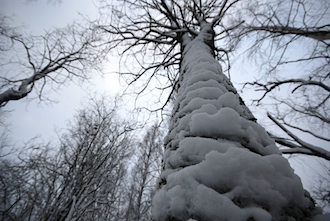
The fresh snow covers some tall aspens in layers like mountainous whipped cream frosting spread randomly on the tree trunks.
The duckboards on the little shortcut path that connects Kortesuo to Viitaniemi are frozen solid under the snow. When the small forest was almost flooding a while ago, the water came right up to the duckboards, and eventually the slush froze, making the surface uneven. That's alright for those of us who are on foot, and we don't mind the narrow pathway. This is no highway anyway.

I step aside to give way to a passing cyclist who complains about the narrow track. Well, the wide asphalt bicycle / pedestrian path is only a 100 meters from here... I'm not in a rush and stop to have a look at the tiny brook which is slowly freezing over.

I reach Viitaniemi and turn left. On Taidepolku lane, a dwarf snowman does its best to scare passers-by.

Soon I arrive at Jaroslavl square (Jaroslavlin aukio) which honours Jyväskylä's twin city Jaroslalvl in Russia. In the shadow of the tallest building of this suburb, Viitatorni - designed by architect Alvar Aalto, there is a lower building which used to house a small supermarket before most people started to go grocery shopping by car. There is a candle burning outside the large windows. Is that an invitation? I step across the snow-covered square and try the door handle.

I get a warm welcome from the smiling lady in black. The newest art gallery in town has opened its doors only some days ago, on Jan 4, 2012. Galleria Variantti is run by Kauko Sorjonen Foundation, and it was founded in celebration of the local patron of the arts / businessman's 70th birthday. The opening exhibition Ihmisiä ja mielenmaisemia (People and landscapes of the mind) presents paintings and small sculptures by Finnish artists from Mr Sorjonen's collection, mostly from late 19th and early 20th century.
The artists include e.g. Ville Vallgren, Alvar Cawén and Fredrik Ahlstedt, but my favourites are Wilho Sjöström and impressionistic Kylpijä, a bathing lady, and especially the small oil paintings that remind me of the still summer evenings: Järvenranta kuutamossa (Lakeside in moonlight) by Hjalmar Munsterhjelm and Elokuun ilta (August evening) by Ellen Favorin.

Until now I've thought that Epiphany is a real Bank Holiday but the shopping bags carried by people who are returning from Jyväskylä city centre reveal that at least some shops are open. As I descend from Harju ridge to Kilpisenkatu street, I realize my wallet is at home so there is no chance for a hot cuppa or anything else that requires a bit of cash.
Luckily, there are things that you can do for free. On Kilpisenkatu street, there is a window display by the Craft Museum of Finland:  Eija Koski's works made of natural materials. The gorgeous, simple wreaths could be displayed at any time of the year but now they seem to spell Xmas. However, the soft and sweet wreath covered in catkins (above) makes you think of Easter... Among other materials, Koski has covered her wreaths in birch bark, dried mushrooms and seedcases.
 
A collection of delicate himmelis, traditional Xmas decorations made of straw, decorate the second window. 
I wonder what the red wrinkled balls in part of the largest himmeli are? Probably dried rosehips.
A couple of steps down and across the street, I arrive at Kauppakatu street. Taidemuseo Holvi, Jyväskylä Art Museum, seems to be open, but what about the entrance fee? Wait a minute, it is Friday and free entrance! It's my lucky day. Downstairs, there is a pretty desolate large work called The World by Noora ja Kimmo Schroderus. Black mountains, steel roads, wrecked cars, people frozen as statues. A dead world to me.

Upstairs, the world seems brighter. I sit down for six minutes to enjoy the enchanting flow of bluish-lilac images that have taken over the wall of the gallery and feel relaxation take over my body. Artist Jaana Partanen displays her works in Mental Alchemy - Harry Potter Layer (don't fancy the name of the exhibition but suppose it hints at the magical element) which is quite captivating. At the next floor, Partanen's exciting 3-D imagery tells individual stories in each photograph that you need to pass very slowly to see the changing images. Quite fantastic, and I love the colours. Science meets the dreamworld.

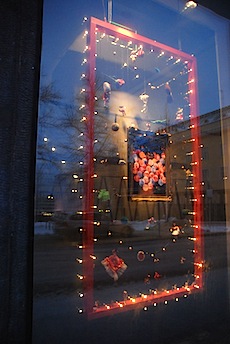
The last work of art I pause to look at is outside Taidemuseo Holvi, on its window. The lady at the ticket counter reveals that this is created by the staff of the museum who happened to decorate the frame in the spirit of Xmas for the holidays. Next week, there may be something totally different!

Thursday, 15 December 2011

Turku: shades and shapes

Without snow, Turku is no city of light at this time of the year. Just like the rest of the country... However, the city doesn't give up. When darkness falls, you will see buildings illuminated, as well as fairy lights and Christmas trees that make their statement against the winter weariness.

Turku Cathedral - the oldest part of which dates to 13th century - stands tall. So tall, that it makes the big Xmas tree in front of its stone steps look almost tiny.

Right next to the medieval cathedral there is a lightweight construction that shines through the darkness like a huge lantern.

The Honeycomb (in Finnish: Hunajakenno) is one of the two Cots of Darkness, designed by Reino Koivula as part of the 876 Shades of Darkness project in which works of art that have been lighting up the darkness during Turku's year as European Capital of Culture. The construction is temporary and it is on display only until the end of 2011. On the opposite shore of river Aurajoki you can get a glimpse of the other cot Kokka, or Bow, that resembles half a boat sunken on the ground. It is possible to enter the cots as well but only in the late afternoon.


I walk to the other side of the river, or as the locals in their own dialect say, tois puol jokke, a saying which has its origins in the time when Turku's old city centre was right here, next to the ancient cathedral. Those days, by crossing the Aurajoki river you stepped out of the city centre.
Strolling down Läntinen Rantakatu street next to the river, I catch a glimpse of strange lights from the city library's back yard. Behind Miina Äkkijyrkkä's huge metal cow there are moving images reflected on the wall above. 
Dark Creatures, animations by local artists, are dancing on the wall. What a great open air movie theatre, be it a silent one! This work of art is also part of the 876 Shades of Darkness project.
The next day I climb back on the top of the Turku Art Museum on the top of the hill, past the Xmas tree that is decorated with tens or hundreds of reflectors and handmade decorations which have survived the hard-blowing wind.


Alright, which door to use to enter the impressive stone building? The left door handle, straight and somewhat dull without its knit graffiti serving as a woollen overcoat is warm to the touch.

However, this door is locked...


Let's try the other door on the right. Be brave! It won't bite! Careful, just take a strong hold of the bronze (and not too gentle looking) panther, grab the fierce creature by the tummy and pull the door open!

What a door handle. Welcome to Turku Art Museum...

The museum is well worth a visit in itself, but also to see the Swedish artist Carl Larsson's excellent exhibition Dreams of Harmony that shows where the ideal of an artistic Swedish home originates. What a couple Carl and his wife Karin made; without her Carl Larsson would not be best known for the beautiful watercolours that romanticize their home and lifestyle. The second floor now displays Crème de la crème, masterpieces from the museum's own collection, as well as contemporary art.
When I descend from the museum back towards the market place and the river, there is a little surprise on the right, in front of the jugend style stone building: a statue of Lenin. There aren't too many such statues in Finland on display... This one was a gift from the city of Leningrad some decades back and has managed to stay there as a reminder of, well, something. Let's look at something prettier. For example at the lovely double doors only few more steps down. A pity the door is locked so I can't see the stained glass from the inside.
Outdoors, you can spot smaller artworks on the corner buildings of the city center: Kortteligalleria project has brought the ancient names of the city blocks here also as imagery. The map beneath the artwork depicts the area where these beauties can be found - all within a short walking distance, surrounding the market place. Next to the market place you can see for example Pyöriäinen (Dolphin) (above; Jenni Tuominen) and Mehiläispesä (Beehive).
On Brahenkatu street I meet a lonely shoe. Poor thing, not nailed to the ground but still getting nowhere... Come to think of it, I'm not going anywhere, just walking about. But at least I'm moving.

Checking out the street corners and the artworks, I meet a Falcon and Sirius (left). No idea where the architect Carl Ludvig Engel got the ideas for the names, but it's nice to think that there's more names to the area than just the street names.

Great that urban artist Meiju Niskala and the team of artists came up with this, to add a bit of history with a modern twist on the streets!


At Lönnrotinpuisto park, next to Aurajoki river, the cot Kokka (by Simo Helenius) is not illuminated during the daytime, and its door is closed as well because it is not two o'clock yet. This should be seen a bit later, when it is again dark. Otherwise, I wouldn't mind seeing the sun for a change.
I cross the river to enter the old city centre and Vanha Suurtori, the Old Market Square, and its Xmas market. This is where the Declaration of Christmas Peace is pronounced at 12 o'clock noon on Xmas Eve, from the balcony of Brinkkala House above. Since Christmas Peace isn't there just yet, the area is now reserved for Xmas shopping, with local producers presenting their goodies, especially handicrafts. Even Santa Claus has joined the band playing Xmas carols for the slowly moving crowd.
I enter the yard behind the old buildings and stop for a snack. Joulupuuro, Xmas pudding (made of rice, cooked slowly) is irresistible, and I am not the only one indulging in it. Definitely cinnamon on top, yes please! This will keep me walking... And for dessert a local sausage with Xmas spices from another stall... Just like last year. This is becoming a tradition.
I come here for culture walks. Thanks Turku 2011, a great culture year!