Sunday, 22 April 2012

Helsinki: Kunsthalle, liquor store and milk

Kunsthalle Helsinki (or Helsingin Taidehalli in Finnish) at Nervanderinkatu 3 has a church-like atmosphere, perhaps because of the echo of footsteps on the stone floor and the height of the rooms upstairs. The tall window at the end of the hall resembles an altarpiece or a stained glass window (even without the stained glass). Appropriate for a temple of art, of course.  
The exhibition by Finnish artist Lauri Laine is called Paintings of Light and Space. Unfortunately, I soon realize that right now I'm more interested in the light and space of the building than of his artwork. This is my first visit to Kunsthalle and there's something so special about the place.
The paintings on the ceiling remind me of something. My thoughts escape back to my hometown Jyväskylä and specifically to Taulumäki church. Later, in my mind I also compare something in Kunsthalle also with Workers' Club (1925) at Jyväskylä, by Alvar Aalto. What do these places have in common? Certainly not the architect, because the architect of Taulumäki church (1928-29) was Elsi Borg, and Kunsthalle (1928) was designed by Jarl Eklund and Hilding Ekelund.  However, they all represent a trend of classicism.
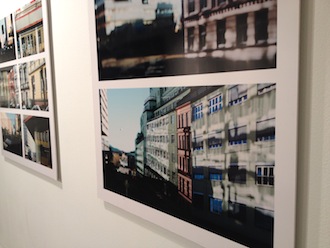
On street level, behind the ticket office, there is a tiny exhibition space called Studio which now houses Heini Hölttä's photography exhibition, Selfportrait as a building: Oslo, Helsinki. There is something really charming about her photographs, and the atmosphere that you sense in them. It seems that Oslo is somewhat dearer to Hölttä than Helsinki.

The café at Kunsthalle is about to close its doors so I can't linger in the building much longer. I head away from the city streets, towards Hietaniemi and the seashore at Lapinlahti bay. Have to watch my step there; the cyclists zoom past very fast. Once back inside the fences of the cemetery, the gravel paths through Hietaniemi cemetery are guaranteed to provide you with peace and quiet, with just the occasional bird or a squirrel. So many lives, so many memories. Having reached the tombs of Finland's former presidents, I turn back towards the city center.
I walk through the busy Kamppi area and can already hear the traffic from Mannerheimintie street. The liquor store Alko Arkadia has simply but nicely decorated windows and if you look closely, you can see an interesting work of art on the wall inside. For a closer look, better step in! I think they used to make this kind of artwork in the 1970's?
The bottom corner of this work of art reveals that it was designed by Aleksi Hautamäki who has also done the interior design of this Alko flagship store. You don't necessarily have to enter a museum or a gallery to see interesting design / art: it can be found also in places like this even if this is not marked with the blue World Design Capital stickers.

Where to next? I choose Kalevankatu street and turn back towards the sea, this time to Hietalahti. In one window I notice a life-sized Spiderman that turns its head all of a sudden. Oh! The body painting job is nearly finished, and there are only some finishing touches to his face left and he'll be ready to go. The sun will set soon...
On Kalevankatu, there are many restaurants, shops and art galleries. At number 33 there is something missing though: the text in black on the wall says MAITOA - MJÖLK (MILK) but the dairy shop is long gone.
The next morning I'm reading the local newspaper (Helsingin Sanomat) and find a short article that features a picture of the same text MAITOA of the pretty building I stopped to look at yesterday. The story advertises Font walk which will help you pay attention to graphic design by looking at different fonts you meet on the way. The map will be available in April... Later the same day, I decide to ignore the rain and get my copy of the Font Walk map from Napa Gallery at Eerikinkatu street.
I close my umbrella and step inside. Napa Gallery is exciting but I feel stupid because I didn't read the article carefully enough; the Font Walk map won't be available until next Wednesday, April 25, 2012.  Sigh. Back into the rain.

Tuesday, 17 April 2012

Jyväskylä: A grey, snowy day

Where have all the colours gone? There seems to be only white and different shades of grey left in the scenery that greets me this morning. The wet snowflakes attack everything that moves or doesn't move.
At the end of Kortesuonkatu street there are the sad remains of Jyvälä, or Nisula estate that housed for example a kindergarten and offered adult education - before someone set it on fire in November 2011. Bit by bit the last remaining part of the building is being torn down.
Next to the Nisula estate, in the yard of the neighbouring apartment building, a felled tree is neatly stacked and waiting for its destiny as firewood.
More snow keeps falling down from the sky. My footprints leave a wet mark on the pavement of Syrjälänkatu street. A car passes me by and slush flies into the air, but luckily it doesn't land on me.
Early in the evening I walk past the Seminaarinmäki campus and slow down in front of Villa Rana building. Quite a few trees have been felled next to its white fence. There are not too many trees left but the remaining ones are protected by red ribbons that say SÄÄSTETÄÄN (to be saved). This adds colour to the day...
Following the Villa Rana fence towards the Jyväskylä University Library, I notice on it a white frame that seems to be missing something. What has disappeared from there or what is still to come there?
The hedge next to Ylä-Ruth, or unofficially Sivukirjasto bar (Branch Library, a nickname it got from being the building next to the University Library), is leafless but not lifeless. The hedge is crying off the melting snow and gaining strength to grow its first green leaves for the spring.
Kuuntele (Listen). Of course I could close my eyes and just listen to the snow melting, water dripping, the sound of gravel beneath my feet. I take a peek at Galleria Patina from behind the window;  Pipa Rauhamäki 's artwork is on display at the exhibition Huhtikuun tytöt (April Girls). A grieving torso of an angel stands on a wooden pedestal that says Kun ikävöin sinua (When I miss you). It makes me think what I'm missing right now: colours. Welcome back, Spring!

Monday, 16 April 2012

France: Cannes - Antibes

Walking by the sea is so tempting that I cannot resist continuing from Cannes to Antibes on foot - yesterday's was such an enjoyable walk. It will be an easy one, totally on level ground. The natural starting point is where I left off the previous afternoon: la Croisette, next to the Palais des festivals and its red carpet. I visit a favourite hand print, that of the mysterious and original Pink Panther.
Before taking off towards Antibes, I check out the film world hand prints once more, and to my surprise I was right about seeing some stars' hand prints there twice. For example Dennis Hopper and the French singer Johnny Hallyday (who has also featured in some films). Their fresh prints are shiny, silvery ones right in front of the festival palace.
La Croisette is busy with tourists, kiosks selling crêpes and coffee, kids playing under the tall palm trees. If you want another film star-related souvenir, just pose behind a cardboard figure (e.g. Charlie's Angels and Jack Sparrow available) and have your photo taken.
Palme d'Or, or the Golden Palm is the symbol of Cannes Film Festival. You can see it also painted on the asphalt, but not everywhere;  the most appropriate place is of course the zebra crossing that leads from the Croisette boulevard to the luxurious Carlton hotel. Or is it the other way round because the stars often have their photo sessions next to the beach?
The people who enter the fancy palace-like hotel are immaculately dressed and the restaurant on the terrace is busy with guests having lunch. I don't think I'm appropriately dressed to march in...
So I'd better continue along the wonderfully wide la Croisette which is getting less crowded, the further I get from the expensive hotels. The beach is almost deserted, thanks to the less sunny day and the wind that blows from the sea.
At the end of la Croisette there is a playing area for children and right in front of it you get a reminder of children's rights (Les enfants ont des droits) in the form of the colourful work of art. The glass paneled fence that surrounds the artwork summarizes the Declaration of the rights of the children.
The coastline curves to Cap de la Croisette and you get a nice view towards Esterel, Théoule-sur-Mer and Cannes. There is plenty of room to walk because only few people seem to be taking a stroll in this area. Some fishermen with their long fishing rods are trying their luck on the rocky shore after the sandy beaches.
At Port Canto there are boats, boats and more boats, from tiny ones to large and expensive ones. It is an art to keep it simple.
At the very end of Cap de la Croisette, the Palm Beach casino invites in people with extra cash. The red foot sculpture (by an anonymous artist) in front of the casino invites different interpretations. Is it a walker's foot, stepping down, or someone standing on tiptoe, or the foot of a woman with an invisible high heel shoe? I walk behind the casino and have a look at the island of Sainte Marguerite which is surprisingly close to mainland right here.
My journey continues along the seashore. On my right there is usually a beach but sometimes there is only the sea, a couple of meters down. Shall I walk down the steps and rinse my feet in the sea? It is not that warm...
The Mediterranian seems a bit colder today, and a different shade of blue than yesterday, even if the sun appears quite frequently. I wonder if I'll be able to walk right by the sea all the way to Juan les Pins and soon the road steers off the shore, across the railroad tracks. There is a narrow path down below but it may well be a dead end because there are private houses ahead. I'd better follow the road, then.
Adieu Cannes; I'm already stepping to the next town. This is the most boring part of the walk, squeezed between the road and railroad tracks with its metal fence. The private houses on the side of the sea seem accessible only by sea or via locked footbridges across the tracks. Glad I followed the road instead.
A villa by the sea on the French Riviera isn't necessarily a luxurious one, not always... Perhaps the view to the Mediterranian sea does not compensate enough for the difficult access to the house and its noisy location right next to the railroad track .
With the arrival at Golfe Juan, the road luckily turns back to the sea. There are some flowers to look at, but otherwise not too much; I focus on simply walking and breathing the fresh air from the sea.
I don't expect to find anything special at Golfe Juan but there is a surprise waiting: at the seafront promenade, full of restaurants, there is also a sign about Napoléon. Emperor Napoléon Bonaparte arrived at this beach from the Isle of Elba, and took off with his troops from Golfe Juan on 1 March, 1815, towards Grenoble which they reached after a walk of 331 kilometres on 7 March.What a March for them...
More boats, couples and families on a leisurely walk on the boulevard. In a flash I'm at Juan les Pins where it is lunchtime, and the tables on the terraces facing the sea are full. Zivo's little elephant, First Found,  seems like it can hardly keep itself together and it has to be content with watching the buildings and passers-by. I turn left after the shiny Casino and follow the shortest route towards Antibes.
Uphill, downhill. I am already close to Vieil Antibes when I take a random turn to the right, towards the sea. Strolling on the boulevard Maréchal Foch, I spot a sign on the gatepost of a villa: Antibes Randonnées, Antibes Hiking club. The club seems to offer very interesting hikes for its members, leading them up into the mountains. Aren't they lucky! However, I'm still quite happy about today's walk, even if I stayed at the same low altitude all the way from Cannes to Antibes.

Sunday, 15 April 2012

France: Théoule-sur-Mer - Cannes

I step off the train at Théoule-sur-Mer with a light backpack just like some other walkers, also equipped with maps. The red and white trail mark that stands for GR 51 (GR = Grande Randonnée, a long distance path) is right in front of the pale pink station, on the other side of the road. Behind the fence something is glittering in the sun: the Mediterranian.
Unfortunately the route doesn't lead you straight to beach which remains down below. I head west along the pavement for a while until the route mark tries to invite me to make a detour uphill. No thanks, I'll keep on this road and take a shortcut... The GR path will anyway wind back down in a moment, via a tunnel under the road. In a few minutes I arrive at Théoule-sur-Mer center and turn right, off the seashore.
A sign tells me that I've just entered Estérel Nature Park, and another that the estimated walking time up to Col du Trayas (245 m) will be about 1h 10 minutes. The gravel path is wide to begin with, following a railroad track and a brook, but very soon I feel almost like in the middle of nowhere. The path starts to ascend slowly, and I'm happy to walk also in the shade of the trees at times, not just in direct sunlight.
I take a sip of water and gaze at the scenery. High above me there are red rocks, as compared to the whitish rocks that you see for example above Eze or Menton. The ground is dry but green enough; there are only few flowers about though. After a moment a couple passes me at brisk space but I prefer to take it slowly, going uphill. Very soon I see also other people enjoying a day out, but most of them are riding a mountain bike; this seems to be a popular route for cyclists.
Although the day is not hot, it is warm enough with the sun shining from a clear blue sky. The rugged path must have had its share of water splashing through it like in a tunnel... It is alright to walk it in a pair of trainers but it is no surprise that quite a few walkers seem to have trekking poles with them. They help especially when walking downhill.
When I've reached my destination, Col du Trayas, I feel tempted about walking further but unfortunately my map doesn't extend far enough west to make a more challenging trip today. I find a spot beneath the pine trees and sit down for a snack - some bread, ham and cheese. An older couple has chosen the same venue for their lunch. The scenery isn't too bad, after all.
I turn to walk back down from Col du Trayas when I notice another trail mark above the red and white GR trail mark. The blue and yellow scallop shell indicates that by following this GR 51 it is possible to reach the popular pilgrimage route to Santiago de Compostela (GR 51 ends in Marseille, where La Voie Phocéenne connects it to Arles, one of the starting points of Camino).
A family of four climbs on the top of a red rock and sits down for their lunch; there are two long baguettes sticking out of the father's backpack. I continue my journey downhill and stop to select the next path. Which way to go?
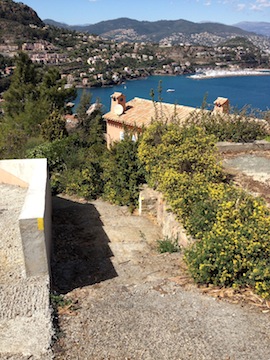
I choose to return to Théoule-sur-Mer round the hill that overlooks Miramar, the neighbouring town. The path offers a lovely view to the sea practically for the whole way. On the next hill on my right the area seems to be full of houses but luckily there is still a lot of unbuilt area around here, thanks to the Nature Park.
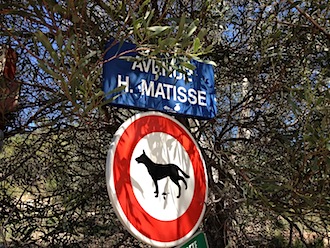
Finally the path winds close to some buildings. The first house that I meet has a curved, turquoise swimming pool with lounge chairs in the middle. The residents of Avenue Henri Matisse want to take it easy, and they don't want to see dog poo on their street.
After a bit of asphalt, I again reach a narrow track that soon climbs up. I also set my foot on concrete steps, walk past red rocks, under tall eucalyptus trees, and get piqued by a juniper with long, angry spikes.
The Mediterranian continues to sparkle in the sun. However, once I've walked round the cape, I'm also rewarded with a view as far as the Maritime Alps with their snow peaks, right behind the hills that surround the French Riviera coast.
The sign on my left tells there's an apricot farm but I have to turn right and take the narrow footpath down to Théoule-sur-Mer. I reach the railway station and decide to walk a bit further, at least to the next station - Mandelieu-La Napoule. The weather is great and it will be an easy walk by the road and close to the sea.
Théoule-sur-Mer offers also a bit of art for the passers-by. Among others, you can meet for example Serge Sallan's Femme sortant de l'eau (A woman rising from the water), and Paradise temple (Temple du paradis) as well as a statue of a princess Diana who used to live in the hills of Estérel.

The road turns and there is a turquoise welcome sign with a French flag ahead. Mandelieu-La Napoule is a town of mimosas but they are not in bloom right now... Mimosa flowers can be seen on the hills in the winter time.
At La Napoule the path leads me through a beach and to the rocks right on the water, at last. At the next beach there is a sturdy palm tree and when you go round the corner, you can see an old castle that is a museum nowadays.
So glad the wind is not hard today, otherwise the waves would easily hit the path both before the castle and while walking under the arches of the castle! After this, the route gets to more level ground.
I cross two rivers, Argentière and Siagne, and face a long stretch of pavement by the side of the road. The cars and motorcycles whiz past me, but I don't mind; it is easy to focus on listening to the waves splash to the shore on my right. Then I hear distant drumming, and think it must come from a car radio, but no: the happy drummers are real!
La Bocca. A young couple walks towards me on the sandy beach, and leaves their footprints on the sand. It only takes a moment for the waves to wipe the footprints away. Perhaps I should board the train in Cannes, not here...
...so I continue my walk just a bit futher, along the seashore. Cannes is crowds of tourists, ice cream eaters, fancy boats, the festival palace with the famous red carpet of the Film Festival, now cordoned off. The end of my walk today. Instead of footprints, there are the famous hand prints on the boardwalk - which one to choose? I can picture different kinds of walks in the films of my favourite Japanese film director, Akira Kurosawa, so he is my pick for today.